
• May 07, 2026

How to Rank in AI Overviews When #1 Rankings Aren’t Enough

Home Blog How to Rank in AI Overviews When #1 Rankings Aren’t Enough

About The Author

Anuj Bajaj

Anuj Bajaj

Anuj Bajaj is the Co-Founder of SIB Infotech and a seasoned digital strategist with over 18 years of experience in website development, SEO, and performance marketing. He leads the agency’s content and digital growth initiatives, ensuring that every piece of content is both search-engine optimized and value-driven. Anuj believes in blending AI-powered efficiency with human creativity to deliver content that educates, converts, and builds authority.

You built backlinks. You optimized your pages. You tracked your rankings every week. And then one day, you hit it. The #1 spot on Google for your target keyword.

So why are your clicks going down?

If you have been asking yourself that question recently, you are not alone. Business owners and marketers across India and globally are seeing the same thing. Rankings are holding. Traffic is dropping. And somewhere at the top of the search results page, Google is now answering the user's question before they even scroll to your link.

That's Google AI Overviews. And it has quietly changed the rules of the game.

In this blog, we are going to break down what AI Overviews actually are, why your #1 ranking may not be enough anymore, and most importantly, how to rank in AI Overviews so your content gets seen, cited, and clicked.

Does #1 Ranking Still Matter in SEO?

Yes. Absolutely. Let's get that out of the way first.

Ranking #1 on Google still means something. It tells Google and users that your page is authoritative, relevant, and trustworthy. It still gets the highest share of organic clicks on pages where AI Overviews don't appear. And it is still a strong signal that your overall SEO is working.

But here is the thing. #1 is no longer the finish line. It is more like getting through the gate.

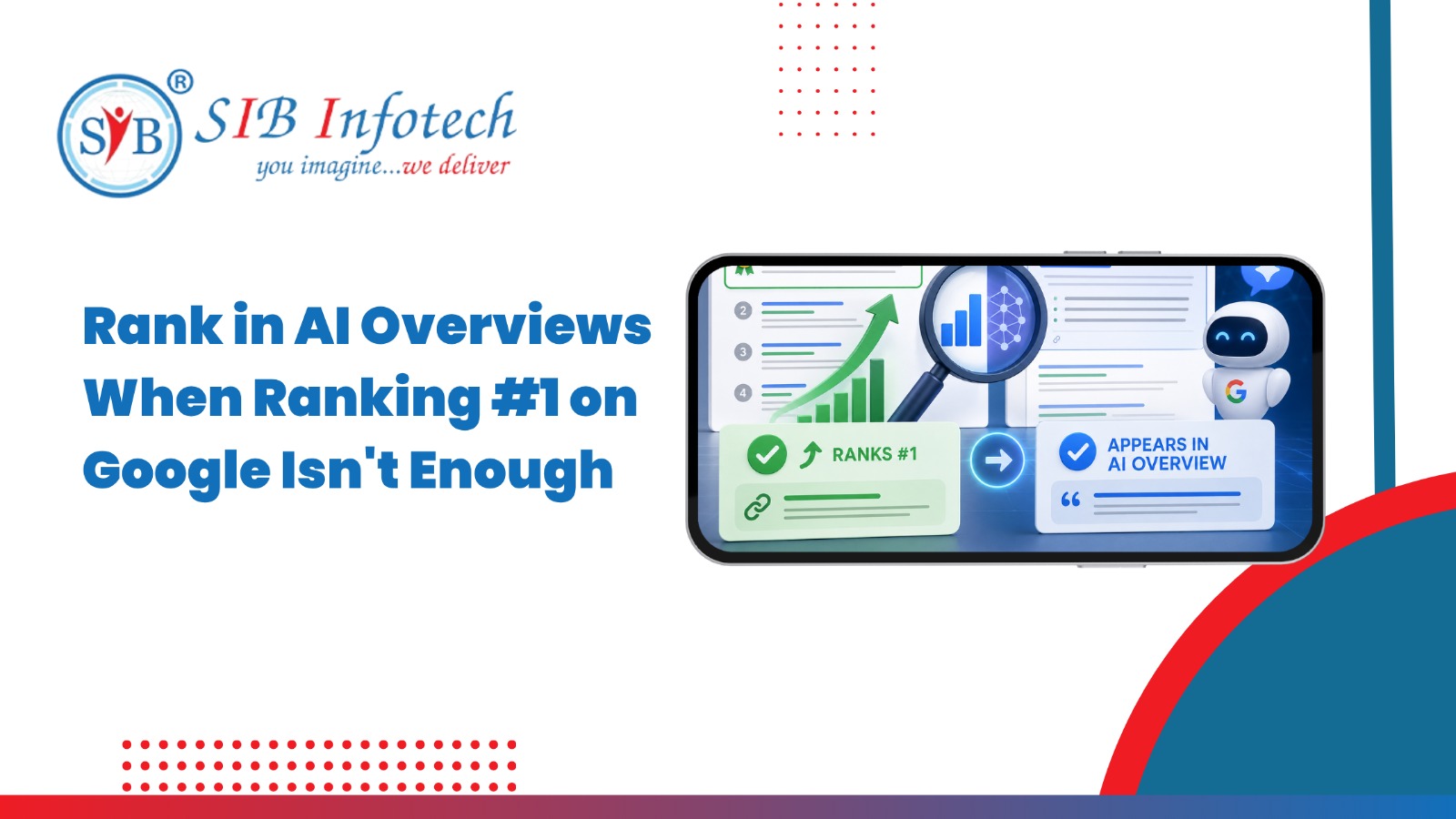
Because above those ten blue links, Google has now placed a new answer box. It reads the web, pulls the best explanation it can find, and presents it to the user right at the top of the page. No scrolling needed. No clicking required.

And the page it pulls that answer from? It is often not the page sitting at #1.

That is the shift. Your ranking tells Google where to list you. But Google AI Overviews decides separately whether your content is worth quoting. Those are two very different decisions made by two very different systems.

Why Your #1 Google Ranking Is No Longer the Whole Story

For about two decades, SEO was straightforward. Rank high, get traffic. The higher you ranked, the more people clicked. It was a simple equation.

The SEO changes with AI overviews have broken that equation. Not completely, but enough that you need a new strategy layered on top of your existing one.

Here is what has changed. When a user types an informational query like "how does GST work for freelancers" or "best time to post on Instagram," Google no longer just lists ten links. It reads multiple pages, synthesises the information, and writes a summary answer at the top of the results page. That summary is the AI Overview.

The user reads the answer. Some click through for more detail. Many don't.

So even if you are ranking #1 below that box, a large chunk of users never reach you. They got their answer already. And the source Google credited in that box? It might be a page ranking at #5 or #12. Or even lower.

This is the new reality of SEO changes with AI overviews. Ranking high is necessary. But being the page that Google trusts enough to quote requires something more.

Can Top-Ranking Pages Be Ignored by AI Overviews?

Yes. And it happens more often than most people realize.

Google ranking vs AI Overviews visibility are not the same thing. Google's ranking algorithm looks at hundreds of signals like backlinks, domain authority, page speed, and keyword relevance. It is built to sort pages in order of quality and trustworthiness.

AI Overviews work differently. Google's AI is not trying to rank pages. It is trying to answer a question. So it scans the top results and asks, "Which page actually gives me a clear, direct, well-structured answer to this specific query?

A page with 500 backlinks and a DA of 70 can absolutely lose to a page with a DA of 25, if that smaller page answers the question more cleanly and directly.

Think of it this way. If you asked a friend, "What is the best way to save tax in India?" you would not want them to give you a 3,000-word essay on the history of Indian taxation. You would want them to say, "Here are five practical things you can do right now." The page that does the second thing is the one AI Overviews will pick.

This is the core gap in Google ranking vs AI Overviews visibility. One rewards authority. The other rewards clarity.

Which Content Gets Selected in Google AI Overviews

So what exactly is Google's AI looking for when it decides to pull from a page?

Based on what we have observed across multiple industries and client campaigns at SIB Infotech, here is the pattern:

Content that gets selected tends to:

  • Answer the query directly in the first 100 to 150 words, not after three paragraphs of preamble

  • Use clear headings, bullet points, numbered lists, or short paragraphs

  • Be factually accurate with no vague or generic statements

  • Demonstrate expertise through author credentials, original data, and cited sources

  • Be updated recently, because stale content loses its edge even if it ranks well

  • Have FAQ sections, which are particularly useful for AI Overview selection

Content that gets skipped tends to:

  • Bury the answer deep in the page

  • Be written for keyword density rather than actual readability

  • Have no structural formatting, just walls of text

  • Lack any signal of who wrote it or why they are qualified to speak on it

The message is simple. Write for a human who wants a quick, clear answer. If your content does that well, the AI will notice.

AI Overviews Visibility Factors: What Actually Moves the Needle

Now let's get practical. Understanding the problem is one thing. Fixing it is another.

The good news is that improving your AI Overviews visibility factors does not mean throwing out your existing SEO work. It means adding a layer on top of it, one that is focused on how your content is written and structured, not just what keywords it contains.

Here are the factors that genuinely matter:

  • 1.
    Answer-first writing:

    The most important shift you can make. Start every page or section with the direct answer to the question the page is targeting. Do not warm up to it. Do not build suspense. Just answer it, then explain.

  • 2.
    Structured formatting:

    Use H2s and H3s to break up your content logically. Use bullet points and numbered lists wherever it makes sense. Keep paragraphs short, three to four lines maximum. AI Overviews visibility factors are heavily influenced by how easy it is for Google's AI to parse your content.

  • 3.
    E-E-A-T signals:

    E-E-A-T stands for Experience, Expertise, Authoritativeness, and Trustworthiness. Google wants to know that the content it is quoting comes from someone who actually knows what they are talking about. Add an author bio. Cite your sources. Reference real data. Include your own experience or case examples.

  • 4.
    FAQ sections with schema:

    FAQ schema is one of the most reliable ways to improve your chances of appearing in AI Overviews. Structure your FAQs as direct question-and-answer pairs, keep the answers concise, and implement FAQ schema markup in your page code.

  • 5.
    Topical authority:

    Do not just write one page on a topic. Build a cluster. If you want to appear in AI Overviews for queries around "Google Ads for small businesses," you should have multiple pages covering different angles of that topic like strategy, budgeting, common mistakes, and industry-specific tips. Topical depth signals that your site is a reliable source on the subject.

  • 6.
    Content freshness

    Update your important pages regularly. Add new data. Refresh examples. Google's AI tends to favour content that is current, particularly for fast-moving topics like digital marketing, finance, or technology.

How to Improve Visibility in AI Search

Beyond content, there are technical signals that support your visibility in AI search:

  • FAQ Schema and HowTo Schema help Google understand the structure and intent of your content

  • Article Schema signals that your page is a well-formed editorial piece

  • Core Web Vitals matter because slow pages may be deprioritized even if the content is good

  • Mobile optimisation is essential since Google indexes mobile-first and AI Overviews follow the same logic

  • Internal linking helps Google understand which pages on your site are most important within a topic cluster

None of these are new ideas in SEO. But they become significantly more important when you are trying to win visibility in AI search, not just rankings.

How to Rank in AI Overviews: A Practical Action Checklist

Let's bring it all together. Here is a straightforward checklist you can apply to your existing content today:

  • Find which of your pages target queries that trigger AI Overviews. Search your target keywords manually in Google and see if an AI Overview appears.

  • Check if your page is being cited. If not, read what is being cited and compare its structure and writing style to yours.

  • Rewrite your opening paragraph. Make sure it directly answers the query within the first 100 words.

  • Add or expand your FAQ section with real questions your audience asks, answered in two to four sentences each.

  • Implement FAQ schema. If you are on WordPress, plugins like Rank Math or Yoast make this straightforward.

  • Add or update your author bio with credentials, experience, and a link to your profile or LinkedIn.

  • Refresh the content by updating statistics, adding new examples, and removing outdated information.

  • Build internal links to and from related pages to strengthen your topical cluster.

  • Run the page through a readability check. Aim for short sentences, simple words, and clear structure.

  • Monitor your appearances using tools like SE Ranking, Semrush, or BrightEdge to track AI Overview visibility over time.

This checklist is essentially what we run through at SIB Infotech when auditing client pages for AI search performance. It is not complicated, but it does require intentional effort.

Google Ranking vs AI Overviews: How to Win Both

Here is the reassuring part. You do not have to choose.

The strategies that improve visibility in Google AI Overviews are largely the same strategies that make your content better overall. Clearer writing, stronger structure, demonstrated expertise and fresh information. None of this works against your traditional SEO. It only adds to it.

The difference is mindset. Traditional SEO optimization is often built around signals like keywords, backlinks, and technical factors. AI search optimization techniques are built around answers. What does the user actually want to know, and does your content deliver it without friction?

When you combine both, you build pages that rank well in organic results and get cited in AI Overviews. That is the double win. Your content appears in the AI answer box at the top of the page, and your blue link is right there below it. Users see your brand twice before they even click anything.

That kind of visibility compounds over time. It builds trust. It builds traffic. And it makes your content genuinely more valuable to users and to search engines.

The shift from pure SEO to a blend of SEO and AI search optimization techniques is not coming. It is already here. The businesses adapting now will have a significant head start.

Final Thought

Ranking #1 on Google is still worth celebrating. It means your SEO is working. But in 2025 and beyond, it is the starting point, not the destination.

The businesses and marketers who understand how to rank in AI Overviews will be the ones who stay visible as search continues to evolve. Because showing up in that AI answer box is not just about traffic. It is about being the source Google trusts enough to quote, and that kind of credibility pays off across every channel.

If your pages are ranking but not appearing in AI answers, your content strategy needs a layer of AEO and GEO thinking built on top of your existing SEO work.

At SIB Infotech, we have been helping businesses stay visible online for over 20 years. With offices in Mumbai and New Delhi, we work with clients across India, the US, the UK, Canada, Australia, and beyond. We are a Google Premier Partner and a trusted name in digital marketing and website development.

We specialize in strategies that evolve with search. Whether your customers are typing a query, asking an AI assistant, or speaking into their phone, we help your business show up in the right place at the right time.

If you are ready to go beyond rankings and build real visibility in AI search, we would love to help.

Not sure where to start? Contact us today and let us talk about what these changes mean for your business and how we can keep your brand visible in the age of AI answers.

Frequently Asked Questions