• Jun 22, 2026

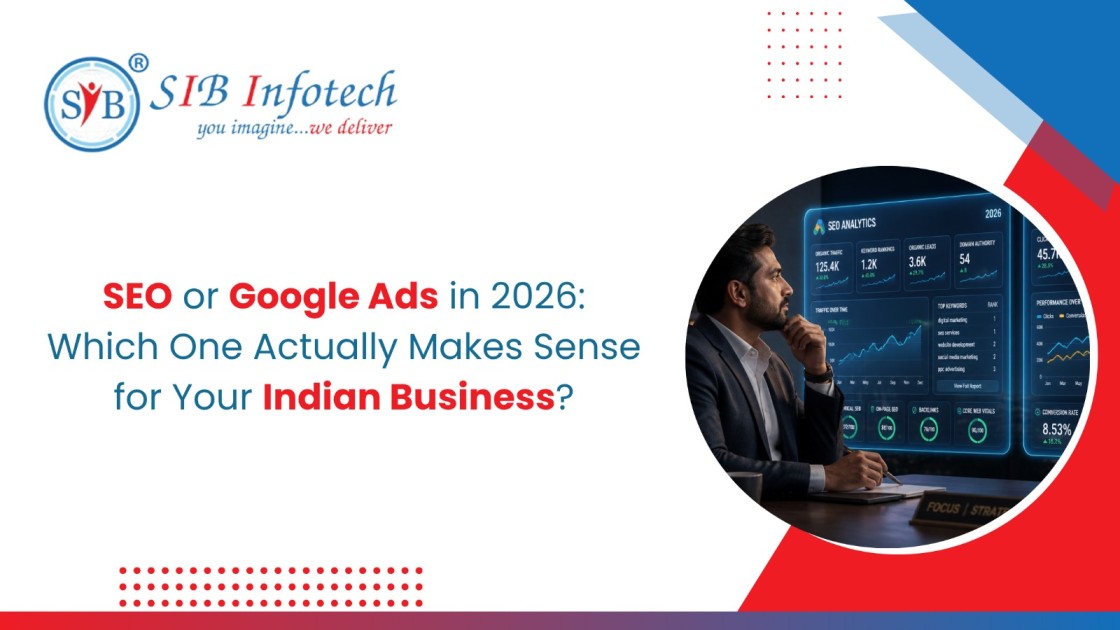
SEO or Google Ads in 2026: Which One Actually Makes Sense for Your Indian Business?

SEO or Google Ads in 2026

Home Blog SEO or Google Ads in 2026: Which One Actually Makes Sense for Your Indian Business?

SEO or Google Ads in 2026

About The Author

Anuj Bajaj

Anuj Bajaj

Anuj Bajaj is the Co-Founder of SIB Infotech and a seasoned digital strategist with over 18 years of experience in website development, SEO, and performance marketing. He leads the agency’s content and digital growth initiatives, ensuring that every piece of content is both search-engine optimized and value-driven. Anuj believes in blending AI-powered efficiency with human creativity to deliver content that educates, converts, and builds authority.

Every few months, this question comes up in some form. A business owner in Pune is spending Rs. 80,000 a month on ads and wondering why his competitor ranks organically and seems to be doing just fine.

A startup founder in Bengaluru refuses to pay for ads and has been waiting 11 months for organic rankings to kick in.

Both are frustrated. Both are probably making the same mistake: treating this as an either/or decision.

But before getting into that, the honest answer to "SEO or Google Ads" depends entirely on your business type, budget, timeline, and what stage of growth you are at.

There is no universal winner. What works for a D2C brand selling skincare online is not what works for a B2B software company in Chennai trying to close enterprise deals.

This blog breaks it down practically, for Indian businesses specifically, in 2026.

The Ground Reality of Digital Marketing in India Right Now

India crossed 900 million internet users in 2025. Mobile-first behavior is not a trend anymore, it is the default. Voice search in Hindi and regional languages is rising. AI-powered search results are changing how Google surfaces answers. And competition across almost every industry has gone up significantly over the last two years.

In this environment, both SEO and paid advertising have evolved. SEO is no longer just about keywords and backlinks. Google Ads campaigns today need sharper audience targeting and better landing pages to deliver results. The fundamentals have not changed, but the bar has gone up on both sides.

What SEO Actually Does for Your Business

SEO builds visibility over time. When done well, it puts your website in front of people actively searching for what you sell, without paying for every click.

For Indian businesses, the case for organic search is strong. A large portion of searches on Google India come from users in the research phase. They are comparing, reading reviews, looking at blogs, and forming opinions before they buy. If your website shows up consistently during this phase, you build trust before the person is even ready to speak to a salesperson.

The downside is time. A realistic SEO timeline for a new website in a competitive niche in India is 6 to 12 months before you see meaningful traffic. For established websites in low-competition niches, results can come faster. But there is no shortcut.

The upside is compounding returns. An article that ranks well today can bring traffic for years without additional spend. For small and medium businesses in India with limited recurring budgets, this is genuinely attractive.

SEO works best when:

  • You are in an industry with high research intent (healthcare, education, legal, real estate, B2B services)

  • You have a content-friendly product or service

  • You are playing a long game and can wait for results

  • You want to reduce dependence on ad spend over time

What Google Ads Actually Does for Your Business

Google Ads puts you in front of people right now. No waiting, no content strategy, no domain authority building. You bid on keywords, set a budget, and your ad shows up when people search.

For businesses that need leads today, this matters. A new coaching institute that opens in July cannot wait until February for SEO to deliver. A retailer running a Diwali sale cannot afford to rely on organic rankings. For time-sensitive, high-intent scenarios, Google Ads vs organic search is not a fair comparison because they operate on completely different timelines.

The challenge for Indian businesses is cost. Click costs on competitive keywords have gone up. In categories like insurance, loans, real estate, and education, cost per click can range from Rs. 150 to Rs. 600 or more. If your conversion rate is low and your average order value does not justify this spend, the math simply does not work.

But when managed well, Google Ads gives you something SEO cannot: precision. You can target specific cities, specific times of day, specific devices, and specific search terms. You can exclude irrelevant traffic. You can test messaging quickly and see what actually converts.

Google Ads works best when:

  • You need leads or sales within weeks, not months

  • You have a defined budget and a high enough margin to justify paid traffic

  • You are launching something new and need quick visibility

  • You are in a competitive market where ranking organically takes years

SEO vs Paid Advertising: The Cost Comparison Indian Businesses Need to See

This is where the conversation gets practical.

A basic SEO retainer with a decent agency in India typically runs between Rs. 20,000 and Rs. 80,000 per month depending on scope, competition, and the agency's track record. You will not see results for the first few months. But by month 8 or 10, if the work has been done well, you could be getting 500 to 2,000 organic visits a month that cost you nothing per click.

With Google Ads, you pay for every visitor. If you are spending Rs. 50,000 a month and your average cost per click is Rs. 100, you are getting 500 clicks. Stop paying, and those visitors stop coming. The traffic is rented, not owned.

When you look at SEO vs paid advertising over a 24-month horizon, the long-term math often favors organic search for businesses with staying power. But the short-term reality often favors ads for businesses that need cash flow now.

The comparison is not really about which one is cheaper. It is about which one matches your current stage and your ability to wait. Both have a cost. SEO costs time and consistent effort. Google Ads costs money and ongoing management attention.

How Indian Business Types Should Actually Think About This

E-commerce and D2C Brands

Most e-commerce brands in India need both, but they need to sequence them smartly. In year one, Google Ads drives traffic while SEO is being built in the background. By year two or three, organic search starts contributing meaningfully and the dependency on ad spend reduces.

Running only SEO in year one for an e-commerce brand is risky because competitors are running ads and capturing buyers you could have converted. Running only ads without building organic is expensive and creates a fragile business model.

Local Service Businesses

A dentist in Andheri, a CA firm in Connaught Place, a wedding photographer in Kolkata. These businesses benefit enormously from local SEO. Google Business Profile optimization, local keyword targeting, and review management can drive consistent enquiries without significant ad spend.

Google Ads can supplement this, especially for high-intent searches like "dentist open Sunday near me," but the foundation for most local businesses is organic.

B2B Companies

For B2B businesses selling to other companies, the buying cycle is longer and search behavior is more research-heavy. Content-led SEO tends to work well here. Decision-makers read articles, case studies, and comparison pages before shortlisting vendors.

Google Ads can work for B2B too, but the cost per lead tends to be higher and the conversion rate is typically lower because of the longer sales process.

Startups and New Businesses

A brand new business with no domain authority, no content, and limited brand recognition needs visibility fast. Google Ads is often the right starting point. It validates whether there is demand for what you are selling and generates early revenue while SEO is being built in the background.

Betting everything on organic search in the first six months of a startup is not a strategy, it is hope.

The 2026 Factor: What Has Changed and Why It Matters

A few things have shifted the Google Ads vs organic search conversation meaningfully in 2026.

AI Overviews in Google Search

Google now shows AI-generated summaries at the top of search results for many queries. This has reduced click-through rates for some organic positions, particularly informational searches. It makes ranking harder to translate into traffic for certain types of content. For transactional and local searches, organic rankings still convert well.

Rising Ad Costs

Average CPCs have continued to climb across most industries. Businesses that relied purely on paid advertising without building organic assets are feeling this pressure more acutely in 2026.

Voice and Vernacular Search

Regional language search is growing fast in India. SEO strategies that ignore Hindi, Tamil, Telugu, or Bengali audiences are missing a significant and growing segment.

Better Attribution

Businesses can now track the customer journey more accurately. This has helped many Indian companies realize that conversions involve multiple touchpoints, often both organic and paid, which makes the old debate between Google Ads or SEO feel increasingly outdated.

When to Run Both (and How to Do It Without Wasting Budget)

For most businesses beyond the startup phase, the right answer is a combined strategy. The question is how to allocate.

A workable split for a mid-size Indian business with a monthly digital marketing budget of Rs. 1,00,000 might look like this:

  • Rs. 40,000 to Rs. 50,000 on Google Ads for high-intent, bottom-of-funnel keywords

  • Rs. 30,000 to Rs. 40,000 on SEO for building long-term organic visibility

  • Rs. 10,000 on content to support both channels

Over time, as SEO delivers results, the ad spend can be optimized or shifted to new campaigns rather than maintaining the same keywords organically.

The key principle: ads capture demand, SEO builds it. Both have a role. The proportion changes depending on your stage and goals.

Mistakes Indian Businesses Make When Choosing Between the Two

Stopping SEO too early.

Most businesses quit 4 to 5 months in because they have not seen results. SEO compounds. Stopping it early means you never see the return on the work already done.

Running ads without a proper landing page.

Sending Google Ads traffic to a homepage or a generic product page is expensive and ineffective. Paid traffic needs focused landing pages built to convert.

Ignoring remarketing.

Many Indian businesses run Google Ads only for new traffic. Remarketing to people who visited your website but did not convert is often more cost-effective and is consistently overlooked.

Treating SEO as a one-time project.

SEO is not something you do once and forget. Algorithm updates, new competitor content, and changing search behavior require ongoing attention.

Comparing the Two: A Quick Reference for Indian Businesses

Factor SEO Google Ads
Time to results 6 to 12 months Days to weeks
Cost model Monthly retainer Pay per click
Traffic type Compounding, owned Rented, stops with budget
Best for Long-term growth Immediate leads
Control Limited (algorithm-dependent) High (targeting, budget, timing)
Ideal stage Established or patient businesses New launches, seasonal campaigns

When Thinking About SEO vs Paid Advertising, Ask These Questions First

Before deciding where to put your budget, answer these honestly:

  • How quickly do you need leads or revenue?

  • Can your margins support a cost per click of Rs. 100 to Rs. 500 or more?

  • Do you have content or a team that can produce it consistently?

  • Is your product or service something people search for by name or by category?

  • Are you building a business for 5 years or trying to hit a quarterly target?

Your answers will point you toward the right channel more clearly than any general recommendation. The SEO vs paid advertising decision is ultimately a business decision, not a marketing one.

So, SEO or Google Ads in 2026?

If you need results in the next 30 to 90 days and have the budget: Google Ads.

If you are building a business for the next three to five years and want to reduce long-term customer acquisition costs: SEO.

If you have been running ads for a year or more and have not started building organic assets: you are already behind and should start SEO now.

If you have been doing SEO for years but are not capturing buyers who are ready to purchase today: run Google Ads or SEO selectively for those bottom-of-funnel keywords and let organic handle the rest.

The businesses winning online in India in 2026 are not picking one over the other. They are using both intelligently, at the right stages, with the right budget allocation. Asking "SEO or Google Ads" is the wrong question. The right question is: what does your business need right now, and what can it sustain over the next two to three years?

Frequently Asked Questions