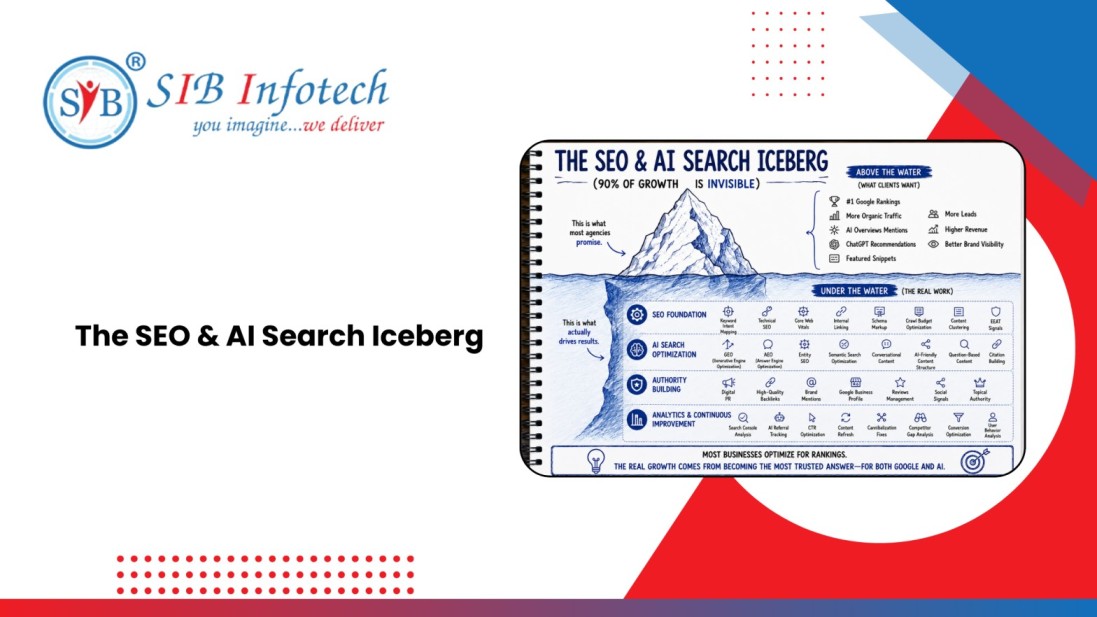
The SEO & AI Search Iceberg: Why 90% of Search Growth Happens Beneath the Surface

There is a reason some businesses get 5x more organic traffic than their competitors despite running similar ad budgets, publishing similar blog posts, and targeting the same keywords. The answer is not what most people think.
It is not more content. It is not a better-looking website. It is not even a bigger backlink budget.
The reason is what those businesses have built beneath the surface.
Search engine optimisation has always worked like an iceberg. The part you can see — your rankings, your traffic dashboard, your AI Overview appearance — is roughly 10% of what is actually happening. The other 90% is underwater, invisible, unglamorous, and the most important work you will ever do for your digital presence.
This blog is about that 90%.
Whether you are a founder trying to figure out why your competitor ranks above you, a CMO evaluating your agency's work, or a CEO who just wants to know where your marketing budget is actually going — this is the clearest breakdown you will find.
When business owners think about SEO, they think about three things: rankings, traffic, and leads. Those are the metrics that show up in monthly reports. Those are the numbers that get discussed in board meetings.
It makes sense. They are visible. They are easy to understand. And they feel like proof that something is working.
But here is the problem with measuring only what you can see: by the time a metric shows up in your report, the decisions that created it were made months ago — sometimes years ago. Rankings are the result of work, not the work itself.
Most businesses operate on a feedback loop that is too short and too shallow. They look at which blog posts are ranking, which keywords drove traffic this month, and whether the contact form got any submissions. If those numbers look okay, they assume SEO is working. If the numbers drop, they panic and start publishing more content.
Neither response gets to the real issue.
The real issue is almost always in the invisible layer — the infrastructure, the architecture, the signals, the entity associations, and the AI-readability of the content that Google and AI search engines use to decide who deserves to be seen.
Before going deeper, it is worth acknowledging what the visible layer actually includes. These metrics matter. They are just not the whole story.
This is the most watched metric in SEO. Your keyword ranking position tells you where you appear in search results for a specific query. Traffic tells you how many people clicked through.
The problem is that ranking positions have become significantly less predictable over the past three years. Google's results pages now include AI Overviews, featured snippets, People Also Ask boxes, local packs, image carousels, and video results — all of which can push traditional blue links far down the page.
A business ranking at position 3 for a keyword might get less traffic than one appearing in an AI Overview, even if that AI Overview does not rank the business at all in the traditional sense.
Google's AI Overviews now appear for a large and growing percentage of search queries — particularly informational ones. According to data from SE Ranking published in early 2026, AI Overviews were appearing in approximately 47% of all Google searches, with significant variation by industry.
Being cited in an AI Overview is not the same as ranking number one. It requires a different kind of content — one that is clear, structured, factually dense, and written in a way that an AI can parse and summarise reliably.
Appearances on ChatGPT, Perplexity, Gemini, and Claude are increasingly valuable as well. These are no longer fringe channels. According to Similarweb data, ChatGPT crossed 3.5 billion monthly visits in late 2024. Perplexity crossed 100 million queries per day. These platforms are where a growing portion of your audience is starting their research — and the brands that appear there did not get there by accident.
This is the metric that actually matters at the business level. Not rankings. Not traffic. Revenue.
And here is the irony: the businesses that focus most obsessively on rankings are often the ones with the weakest connection between organic search and revenue. That is because traffic without the right intent, without the right landing page, and without the right conversion path does not convert. All of that lives in the invisible layer.
This is where most businesses have gaps. And where the best-performing ones have built serious, compounding advantages.
Keyword research in 2026 is nothing like it was in 2015. Back then, you could find a high-volume keyword, write a page targeting it, and reasonably expect to rank. That era is over.
Today, the first question before targeting any keyword is: what does someone actually want when they type this? Google's systems are now sophisticated enough to understand that someone searching "how to fix a leaky pipe" wants a step-by-step guide, not a plumber's service page. Someone searching "emergency plumber Mumbai" wants a local result with a phone number, not a blog post.
Misaligning content with intent is one of the top reasons pages fail to rank despite being well-written. You can produce the most comprehensive article on a topic and still get outranked by a competitor who understood what the searcher actually needed at that moment.
Good keyword strategy also accounts for the full funnel — not just high-volume informational terms, but the commercial and transactional queries that sit closer to purchase decisions. Those are often lower volume but dramatically higher in revenue impact.
Technical SEO is not glamorous. It does not produce anything you can show to a client in a presentation. But it is the reason why some websites consistently outperform competitors who publish better content and have more backlinks.
Technical SEO covers a lot of ground:
Here is a shift that has happened gradually but is now very hard to ignore: Google does not just rank individual pages anymore. It evaluates websites as a whole to determine whether they have genuine authority on a topic.
This is what "topical authority" means. If your website covers a narrow subject comprehensively — answering every meaningful question a reader might have, from foundational to advanced — Google starts to treat it as a reliable source on that topic. That trust flows to individual pages.
The opposite is also true. A website that publishes scattered content across ten different industries rarely develops deep authority in any of them. Each new page competes for relevance against better-established sources rather than reinforcing the site's existing authority.
A useful analogy: think of a library. A library with 200 books on cardiology is a better source of cardiac information than a library with 2,000 books spread equally across every medical specialty. Topical depth beats topical breadth when it comes to authority signals.
Internal linking is consistently underestimated. Most websites treat it as an afterthought — adding a few links to related posts at the bottom of an article and calling it done.
But internal linking does something critical: it passes authority between pages and tells search engines which content is most important. A page with ten internal links pointing to it is, by default, more important to your site than a page with one.
Smart internal linking also creates contextual clusters — groups of pages that reinforce each other's relevance. A main services page linking to supporting blog content, case studies, and FAQs creates a web of contextual signals that improves the rankings of every page in the cluster.
Schema markup is code you add to your website that helps search engines understand what your content is about — not just what the words say, but what they mean.
A page can say "Dr. Anjali Mehra has been practising dentistry since 2004." That is useful. But with schema markup, you can tell Google: this is a person, she is a medical professional, her specialty is dentistry, she is affiliated with this organisation, and this is her rating from patients. That structured information is what powers rich results in Google and, increasingly, what gets pulled into AI-generated answers.
As AI search engines become more prevalent, schema markup goes from being a nice-to-have to being a competitive necessity. AI systems are fundamentally pattern-matching machines. The clearer your data, the more confidently they cite you.
As mentioned above, Core Web Vitals measure three dimensions of page experience: loading speed, visual stability, and responsiveness to interaction.
What is less well understood is how much variance exists between websites that look fine and websites that actually pass Core Web Vitals assessments. A website that loads in 2.8 seconds might look fast to a user on a fast connection but still fail LCP benchmarks when measured on a mobile device on a 4G connection — which is how Google's crawlers test it.
Businesses that invest in Core Web Vitals optimisation often see ranking improvements that have nothing to do with their content. The page was always good. Google just needed better proof that users were having a good experience before trusting it at scale.
E-E-A-T stands for Experience, Expertise, Authoritativeness, and Trustworthiness. Google introduced this framework in its Search Quality Evaluator Guidelines, and it has become an increasingly important lens through which content is evaluated — particularly in high-stakes categories like health, finance, legal, and anything involving major purchase decisions.
Experience refers to first-hand knowledge. A blog post about recovering from a knee replacement written by someone who had the surgery carries more trust signals than one written by a generalist. Expertise is demonstrated through credentials, citations, and the depth of knowledge in the content. Authoritativeness is built over time — it is a function of who links to you, who cites you, and whether your brand appears in credible contexts across the web. Trustworthiness is about accuracy, transparency, and the signals on your own website — clear contact information, a genuine About page, secure connection, and accurate content that does not mislead.
Getting E-E-A-T right is not a one-page fix. It is a reputation system, and it takes time to build.
Backlinks — links from other websites to yours — remain one of Google's most powerful ranking signals. This has not changed fundamentally since PageRank was invented. What has changed is how you build them.
Bulk link-building through directories, forum posts, and paid placements no longer works and can actively harm your site. What works is earning links through content that deserves to be cited.
That means investing in original research, publishing data that journalists and bloggers will reference, creating resources that genuinely help people, and building relationships with publications in your industry. This is what "digital PR" means in an SEO context — creating assets that generate links as a byproduct of their value.
A single link from a high-authority publication in your industry can be worth more than 200 links from low-quality directories. The source and the context matter enormously.
GEO is the practice of optimising your content to appear in AI-generated search results — the kind produced by Google's AI Overviews, Perplexity, ChatGPT, Gemini, and Claude.
The optimisation principles are different from traditional SEO in important ways. AI systems do not just look for pages that rank highly — they look for content that is factually clear, well-structured, directly answers questions, and comes from sources they associate with reliability on a given topic.
For GEO, the key practices include:
AEO is closely related to GEO but focused specifically on being the answer — not just being cited.
When someone asks a voice assistant, a chatbot, or a search engine a direct question and gets a single answer back, that answer came from somewhere. The brand that provides that answer gets a significant visibility advantage. The brand that doesn't is simply invisible for that query.
AEO optimisation focuses on FAQ content, structured Q&A formats, schema markup for questions and answers, featured snippet optimisation, and writing that anticipates and directly addresses the exact questions people are asking.
The shift toward answer engines changes the game for many businesses. A company that ranks number four for a keyword might still appear as the primary answer on ChatGPT or Perplexity if its content is better structured and more clearly answers the underlying question.
Traditional SEO was keyword-driven. Modern SEO is entity-driven.
An entity is a thing — a person, a place, a brand, a concept — that Google has definitively identified and associated with specific attributes. When Google knows that your brand is an entity, it can associate it with related topics, understand context without relying purely on keyword matching, and display it in knowledge panels and AI-generated results.
Building entity recognition means consistent NAP (name, address, phone) data across the web, Wikipedia or Wikidata presence where applicable, Knowledge Graph inclusion, consistent brand mentions across credible sources, and structured data that explicitly identifies your organisation as an entity.
For businesses with strong entities, there is a compounding effect: Google becomes increasingly confident about what the brand is, what it does, who it serves, and why it matters — and that confidence gets reflected across all search and AI results.
Structured data is the technical implementation of schema markup at scale. It includes JSON-LD code on your pages that explicitly classifies content for machines.
AI-friendly content goes beyond structured data. It means writing in a way that a large language model can parse accurately:
This is not a compromise with your audience — it is actually better writing. Content that an AI can parse clearly is also content that humans find easier to read.
Too many businesses set up Google Search Console, look at it once, and never return. That is a significant missed opportunity.
Search Console is a goldmine of data about how Google actually sees your website. It shows you which queries trigger your pages, what your average positions are, where you are getting impressions without clicks, and where Google is struggling to crawl or index your content.
Continuous optimisation means building a process around this data:
| Dimension | Visible SEO | Invisible SEO |
|---|---|---|
| Examples | Rankings, traffic, AI Overview mentions | Technical health, schema, entity signals, E-E-A-T |
| Measured by | Google Analytics, rank trackers | Search Console, site audits, CWV reports |
| Who notices | Business owners, clients | SEO specialists |
| Time to impact | Visible within days or weeks | Months of compounding work |
| Ease of copying | Competitors can mirror visible tactics quickly | Hard to replicate, builds moat |
| AI search relevance | Surface-level citations | Determines whether AI trusts and cites you |
| Typical investment | Content production budget | Technical + content + authority strategy |
| Longevity | Drops quickly if work stops | Compounds over time |
| Agency reporting | Usually what's in the monthly report | Rarely shown, even when it's being done well |
| Revenue impact | Indirect, delayed | Direct, because it determines ranking quality |
Running SEO audits across hundreds of websites over the years reveals a consistent set of errors. The same mistakes appear across industries, company sizes, and budgets.
Businesses that decide to "do content marketing" often start writing blog posts about topics that feel relevant without asking whether those topics have search demand, what intent they serve, or how they connect to other content on the site. The result is a collection of isolated articles that never build topical authority.
Websites accumulate technical problems over time — redirects that chain unnecessarily, pages that are accidentally noindexed, duplicate versions of the same URL, broken internal links. These compound over time and can significantly limit the impact of content investment.
Search is a dynamic environment. Google updates its algorithm hundreds of times per year. Competitors publish new content. User behaviour shifts. Treating SEO as a project with a start and end date rather than an ongoing function is one of the fastest ways to see rankings decay.
A business can rank number one for a keyword that drives no revenue because the intent behind that keyword does not align with what the business sells. Intent matching is more important than volume.
Many businesses skip the foundational trust-building work — detailed About pages, named author profiles, verifiable credentials, third-party citations — because it feels peripheral. For AI search particularly, this is a serious mistake.
The gap between traditional SEO and what might be called AI SEO is widening, and it matters.
Traditional SEO was built around a relatively simple model: identify keywords, produce content, earn links, measure rankings. That model still has relevance, but it is increasingly insufficient.
AI SEO — optimising for AI-powered search experiences — requires additional layers:
| Traditional SEO | AI SEO |
|---|---|
| Keyword optimisation | Intent and entity optimisation |
| Blue link rankings | AI Overview and answer engine citations |
| Backlinks for authority | Brand signals, entity recognition, third-party mentions |
| Meta tags and headers | Structured data and schema at scale |
| Traffic as success metric | Citation frequency and brand recommendation as success metric |
| Page-level focus | Topic cluster and entity-level focus |
| Human readability | Machine parseability alongside human readability |
| Quarterly strategy reviews | Continuous optimisation |
The businesses that are winning in AI search right now built most of their advantage through invisible SEO work that started two or three years ago. The ones starting today are not too late — but the window for building that advantage without significant investment is closing.
Most agencies look similar from the outside. They all promise rankings. They all show dashboards. They all produce monthly reports.
Here are the questions that separate serious agencies from the ones that will cost you two years and a meaningful budget with nothing to show for it.
A good agency should be able to walk you through their site audit methodology, the tools they use, and how they prioritise fixes. Vague answers here are a red flag.
Ask them to explain what that means and how they would build it for your business. If they have not thought about content at the cluster level, they are playing an older game.
Specifically, ask about GEO, AEO, and entity SEO. Ask whether they track AI Overview appearances and Perplexity citations. This is where the industry is heading and where a significant portion of your audience already is.
They should have a process for evaluating and improving trust signals. If they have not thought about this, their content strategy has a ceiling.
Any agency worth working with should want to understand the technical state of your website before promising results. If they skip this step, they are not doing proper work.
A good agency has a clear rhythm — what they are doing each month, why, and how it connects to the larger strategy. If the answer is "we publish two blogs and track your rankings," that is not a strategy.
SEO is not dying. It is bifurcating.
There will be a version of search that continues to produce ranked lists of blue links for navigational and transactional queries. Google has too much commercial infrastructure built around that model to abandon it entirely.
But there is a parallel track — already well underway — where AI systems answer questions, recommend products, summarise information, and guide decisions without users ever clicking through to a website. In this version of search, visibility is not about ranking. It is about trust, authority, and brand recognition at the machine level.
The businesses that will thrive in this environment are not necessarily the ones with the biggest content budgets. They are the ones that have built genuine authority — consistent, structured, verifiable, well-cited — across both human and machine audiences.
A few developments to watch:
The iceberg analogy holds because it is accurate, not because it sounds clever.
Most of what determines your search performance — in Google, in ChatGPT, in Perplexity, in Gemini, in whatever AI search tool your customers are using six months from now — is invisible. It is built through consistent technical work, structured content strategy, genuine authority signals, and the kind of deep foundational investment that does not produce a satisfying graph in the first monthly report.
The businesses that understand this build search equity that compounds over years. The ones that chase rankings in isolation find themselves on a treadmill — constantly producing content, constantly watching positions fluctuate, never quite understanding why their well-resourced competitor always seems to be ahead.
The difference is almost never what you can see.
Google ranks pages. AI recommends trusted brands. The difference is everything you build beneath the surface.
If you want your business to be found by the right audience — in traditional search, in AI Overviews, in voice answers, and in the channels that do not exist yet — that work starts below the waterline.
The question is not whether to build it. The question is how much of a head start you are going to give your competitors while you wait.