Google Ads Keyword Match Types Explained (2026 Guide with Smart Bidding)
.webp&w=3840&q=100)
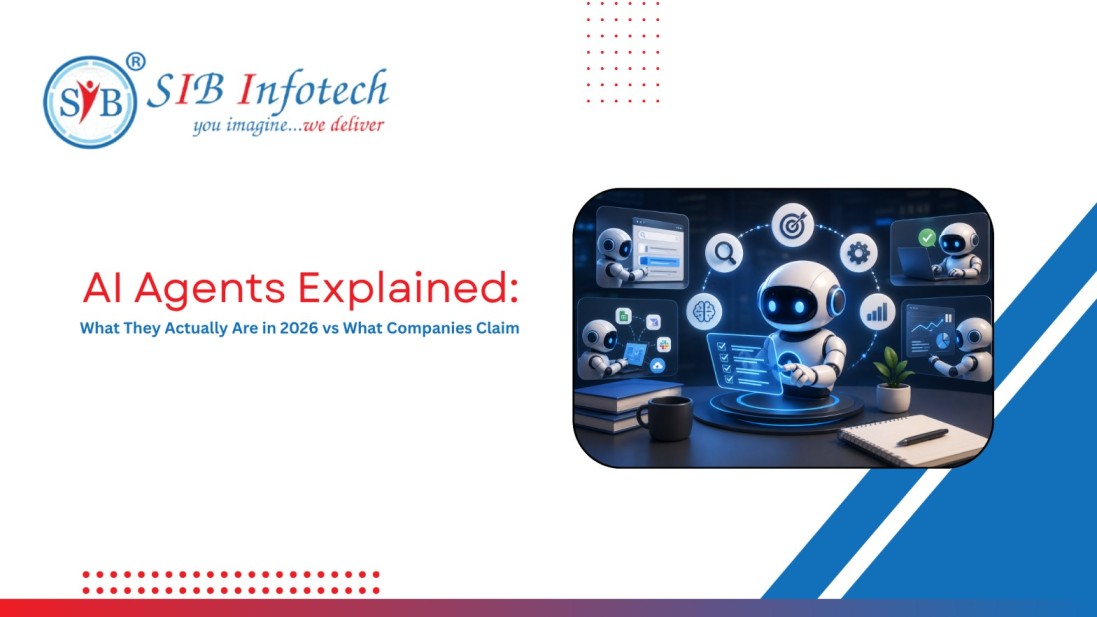

Every tech company seems to have an "AI agent" now. It's plastered across product pages, investor decks, and press releases with the kind of breathless enthusiasm usually reserved for revolutionary breakthroughs. But spend five minutes digging beneath the surface and a familiar pattern emerges — the gap between marketing language and actual capability is wide, and for businesses trying to make real decisions, that gap is expensive.
So let's cut through it. Here is an honest breakdown of what AI agents actually are in 2026, what most companies are actually shipping, and why the distinction matters more than ever.
To understand what an AI agent actually is in 2026, we must first strip away the marketing hyperbole. An AI agent is not merely a Large Language Model (LLM) wrapped in a slick user interface. It is a complex, multi-component software system where the LLM serves as the central reasoning engine—the "cognitive core"—surrounded by specialized subsystems that enable perception, memory, reasoning, and action.
Unlike traditional software, which operates on deterministic, hardcoded paths, a genuine AI agent is non-deterministic and goal-oriented. You define the objective, provide the boundaries, and the agent autonomously determines the optimal sequence of steps to achieve that goal.
The foundation of any agent is its underlying foundation model. In 2026, this has evolved beyond basic text completion to multimodal reasoning models capable of native tool-calling, structured JSON output generation, and advanced logic processing. These models do not just predict the next word; they run internal "Chain-of-Thought" (CoT) or "Tree-of-Thoughts" (ToT) loops to evaluate multiple potential paths before executing an action.
A simple chatbot treats every interaction as a blank slate (stateless). A true AI agent possesses a sophisticated, multi-tiered memory architecture:
This is the defining characteristic of agentic workflows. Instead of executing a single pass, a genuine agent utilizes frameworks like ReAct (Reasoning and Acting). It analyzes a goal, breaks it down into sub-tasks, executes the first sub-task, observes the outcome, reflects on whether the outcome brings it closer to the goal, and dynamically adjusts its next steps.
The ReAct Loop in Action:
Thought: "I need to analyze the competitor's backlink profile, but the primary API is rate-limited."
Action: Call the backup custom scraping tool with a delayed batch request.
Observation: "The tool returned 150 high-authority domains, but 20% are redirect chains."
Reflection: "I must filter out the redirect chains before compiling the final SEO recommendation report."
An agent without tools is like a brain in a jar. To affect the real world, agents are granted access to an "action space"—a suite of APIs, database connectors, web browsers, and sandboxed code execution environments. Through native function calling, the agent translates its cognitive decisions into structured API payloads, executes them, and parses the return data to inform its next step.
---As the term "AI Agent" has captured the market's imagination, software vendors have rushed to rebrand their existing, static products. This phenomenon—which we call "Agent Washing"—makes it incredibly difficult for enterprise buyers to distinguish between transformative technology and basic automation scripts.
Most "agents" marketed today fall far short of true autonomy. Instead, they are glorified linear workflows or basic Retrieval-Augmented Generation (RAG) systems. To help you navigate this landscape, we have mapped out the differences across the technical spectrum:
| Capability / Feature | Simple Chatbot / RAG (Level 1) | Linear Chain / Automation (Level 2) | True Autonomous Agent (Level 3) |
|---|---|---|---|
| Execution Path | Single-turn response based on retrieved context. | Hardcoded, sequential steps (A → B → C). | Dynamic, non-linear pathing determined at runtime. |
| Error Handling | Fails or hallucinates when context is missing. | Breaks completely if an API call fails or returns unexpected data. | Self-reflects, debugs errors, and tries alternative strategies. |
| Memory Persistence | None (stateless) or limited to current chat session. | State is stored in a rigid database schema. | Continuous episodic and semantic memory across runs. |
| Tool Usage | Read-only retrieval from a vector index. | Pre-configured API triggers with static parameters. | Dynamic tool selection, parameter generation, and code execution. |
| Human Intervention | Required for every single prompt. | None, or hardcoded manual approvals. | Collaborative "Human-in-the-Loop" (HITL) at key decision gates. |
As research published on arXiv on Agentic Workflows demonstrates, the transition from zero-shot prompting to iterative, agentic reasoning loops yields massive performance gains—often outperforming much larger models running on basic single-turn prompts. When evaluating vendor claims, ask for their architecture diagrams: if there is no feedback loop, no state-machine orchestration, and no dynamic tool-selection layer, it is not an agent.
---Building an agentic system that can run reliably within an enterprise environment requires moving past simple Python scripts. You need an architecture designed for scale, security, and observability.
Enterprise Agentic Stack (2026)
In the early days of generative AI, linear frameworks like LangChain were sufficient. However, true agents require cyclical graphs—where the output of step C can route back to step A for refinement.
In 2026, LangGraph has emerged as the industry standard for developer-centric, highly controlled agentic state machines. It allows developers to define agents as nodes in a graph, with edges representing the conditional routing logic. CrewAI, on the other hand, excels at role-playing multi-agent systems, where distinct agents (e.g., a "Researcher Agent" and a "Writer Agent") collaborate, pass messages, and delegate tasks to one another.
To prevent agents from getting lost in massive datasets, modern architectures employ semantic routing. When a user input or tool output is received, a lightweight, high-speed classifier model determines which specialized agent or database should handle the payload.
This is coupled with a hybrid memory fabric. While vector databases (like Qdrant or Pinecone) handle semantic similarity searches, graph databases (like Neo4j) preserve the complex, structured relationships between entities (e.g., mapping how a specific product feature relates to customer support tickets and developer documentation).
Enterprise deployments cannot tolerate unconstrained agent behavior. A robust guardrail layer is mandatory. This layer acts as a real-time proxy, inspecting inputs for prompt injection attacks and evaluating agent outputs for hallucinations, toxic language, or data leakage before they reach the user or external APIs.
For businesses looking to deploy these technologies, ensuring your underlying digital infrastructure is secure and optimized is paramount. Integrating these complex agentic systems with custom enterprise portals requires specialized web development solutions that can handle real-time asynchronous data streams, secure API authentication, and stateful user sessions.
---While the tech sector is filled with theoretical use cases, forward-thinking brands are already deploying true agentic systems to gain a competitive edge. In the realm of digital marketing services, the transition from static automation to autonomous agents is driving unprecedented efficiency.
Traditional marketing automation relies on static rules (e.g., "If CPC exceeds $5, lower the bid by 10%"). An AI marketing agent, however, operates with a broader mandate: "Maximize qualified lead generation within a $50,000 monthly budget."
The agent continuously monitors performance across platforms, analyzes attribution data, drafts new ad copy variations, and dynamically shifts budgets. When integrated with professional Google Ads management services, these agents can run thousands of micro-optimizations daily, identifying high-performing audience segments and executing real-time bid adjustments far faster than any human operator.
SEO is no longer just about keyword stuffing; it is about semantic relevance, user intent, and technical precision. Modern AI agents can autonomously crawl your website, identify crawl budget bottlenecks, analyze competitor content gaps, and generate comprehensive content briefs.
By leveraging advanced technical SEO services, these agents can even draft schema markup, optimize internal linking structures, and submit real-time indexing requests to search engines. Furthermore, as search engines evolve into answer engines, these agents play a critical role in structuring your brand's data for Generative Engine Optimization (GEO), ensuring your content is easily parsed and cited by other AI search agents.
Our 4.8 average client rating is built on delivering the results we promise. From SEO rankings and lead generation to web development and paid marketing, our clients across 40+ countries have shared their experience publicly.
4.8

Digital Marketing and SEO Agency Reviews about SIB Infotech


Rupesh Maniar
Real Value Finloan Services Pvt. Ltd.
SIB Infotech has designed website for our company. We are very happy with outcome. They are not only professional but also putting their heart into work. We will always refer them for quality work and perfect price.
Reviewed From


Tima Elhajj
CEO & Founder, Tima Media
The client loved the platform that the SIB Infotech team developed for them, especially the calculator function. The company appreciated the team's high level of professionalism, communication, and care on the project. They are happy and willing to work with the team again.
Reviewed From