Google Ads Keyword Match Types Explained (2026 Guide with Smart Bidding)
.webp&w=3840&q=100)
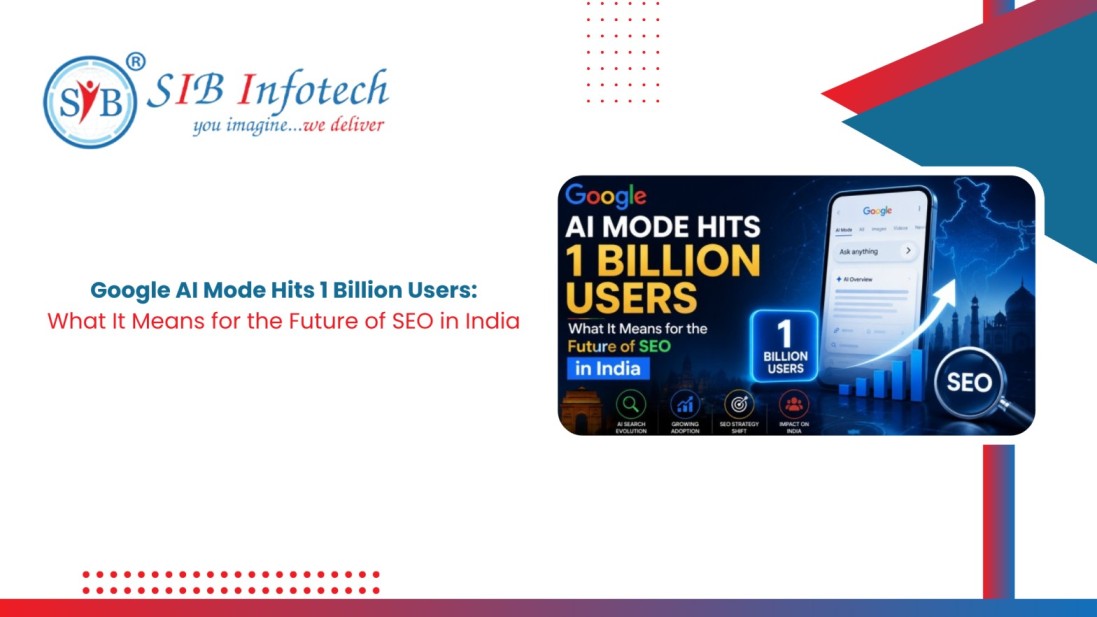

Google AI Mode has crossed 1 billion users. That number is not a forecast or a projection. It has happened. And for businesses, marketers, and SEO professionals in India, it raises a question that cannot be ignored: does this change everything about how search works?
The short answer is yes, some things have changed. But the future of SEO in India is not a story about SEO dying. It is a story about SEO evolving faster than most businesses are prepared for.
This blog breaks down what is actually happening, what Google announced at I/O 2026, and what Indian businesses need to do to stay visible in an AI-first search world.
To understand how to optimize for Google AI Mode, we must first understand what it is under the hood. Announced and refined during successive iterations of Google I/O, Google AI Mode represents the integration of advanced Gemini large language models (LLMs) directly into the core search infrastructure. It is not a separate search engine; rather, it is a dynamic processing layer that sits between the user's query and the traditional index.
When a user inputs a query in AI Mode, Google does not merely run a keyword-matching algorithm. Instead, it initiates a complex multi-step pipeline:
For businesses leveraging SEO services, this means the goal has shifted. It is no longer enough to rank blue links on page one. The new objective is to become the trusted source of truth that Google's RAG pipeline extracts, synthesizes, and cites within the AI Overview.
"AI Mode does not bypass the web; it curates it. The websites that provide the most structured, authoritative, and contextually rich answers are the ones that Google's Gemini models choose to cite."
India's digital ecosystem is unlike any other in the world. With over 900 million active internet users, the market is characterized by massive linguistic diversity, a mobile-only user base in rural areas, and an unprecedented reliance on voice search. As Google AI Mode scales across the subcontinent, these unique characteristics are shaping how generative search behaves in India.
A significant portion of Indian internet users search using a mix of English and regional languages, commonly referred to as "Hinglish" (Hindi-English), "Tanglish" (Tamil-English), or "Benglish" (Bengali-English). Google's Gemini models have been specifically trained on these hybrid linguistic datasets.
In AI Mode, Google can seamlessly interpret a query like "best budget smartphone under 15000 jo gaming ke liye accha ho" (best budget smartphone under 15000 that is good for gaming) and synthesize a response that lists devices, citing Indian tech blogs that have reviewed these phones. If your content is only optimized for formal English, you are missing out on the vast majority of conversational search volume in India.
Voice search is no longer a novelty in India; it is a primary navigation tool. Users in Tier 2 and Tier 3 cities frequently use the microphone icon to ask long-tail, conversational questions. Google AI Mode is perfectly optimized for this behavior. Because LLMs excel at processing natural, conversational language, voice queries trigger AI Overviews far more consistently than short, fragmented keyboard searches.
To capture this traffic, brands must transition from targeting rigid keyword strings to answering natural-language questions. This requires a deep integration of conversational content patterns, which is a core focus of modern digital marketing services.
The traditional Search Engine Results Page (SERP)—consisting of ten blue links, featured snippets, and paid ads—is undergoing its most radical transformation since the launch of universal search. In Google AI Mode, the top of the fold is dominated by the **AI Overview (AIO)**.
| Feature / Metric | Traditional Search (Pre-AI) | Google AI Mode (2026) |
|---|---|---|
| Primary Real Estate | Organic Blue Links & Featured Snippets | AI Overviews (AIO) with dynamic citation cards |
| User Query Style | Short-tail, keyword-based (e.g., "best digital marketing agency") | Long-tail, conversational, multi-turn (e.g., "which agency can help me scale my D2C brand in India using AI?") |
| Click-Through Rate (CTR) | High CTR for top 3 organic positions | Lower overall organic CTR (zero-click), but highly qualified traffic for cited sources |
| Ranking Factor Focus | Backlinks, keyword density, technical site health | Entity authority, structured data, E-E-A-T, semantic relevance |
| Paid Advertising Integration | Standard text ads above/below organic results | Sponsored products and services contextually embedded within the AI response |
Because the AI Overview answers the user's question directly on the search page, "zero-click" searches are rising. Users no longer need to click through to multiple websites to compare information; the AI does it for them.
However, this is not the death of organic traffic. Instead, it is a filtering mechanism. The clicks that *do* occur are highly transactional and deeply qualified. When a user clicks an inline citation within an AI Overview, they are already pre-sold on the credibility of that source. To capture these high-value clicks, your brand must be woven into the "Citation Graph" of Google's LLM.
Google's AI Mode relies on a citation graph to attribute facts. This graph is constructed by analyzing the consensus of information across the web. If multiple authoritative, independent sources (news sites, industry blogs, academic papers, government portals) agree on a fact, Google's model is highly likely to use that fact and cite those sources.
For Indian businesses, this highlights the critical importance of Off-Page SEO and Digital PR. If your brand is not mentioned alongside your industry's core topics on external, authoritative sites, the AI will not recognize you as an entity worthy of citation.
As traditional SEO paradigms shift, a new discipline has emerged: Generative Engine Optimization (GEO). GEO is the practice of optimizing digital assets to maximize visibility within AI-driven search engines and conversational assistants.
Academic research and industry testing have revealed several optimization vectors that significantly increase the likelihood of a website being cited by generative search engines:
Pro-Tip: The "Quote-Ready" Content Strategy
To increase your chances of being cited in AI Overviews, structure key insights into concise, highly quotable sentences (15-25 words) that directly answer a specific question. Google's RAG pipeline excels at pulling these "bite-sized" factual nuggets directly into the synthesized response.
While content relevance and authority are critical, they are useless if Google's AI crawlers cannot efficiently access, parse, and understand your website. This is where advanced technical SEO services become indispensable.
Structured data (Schema markup) is the primary language of the semantic web. It allows you to explicitly tell Google's AI what your content means, how different entities relate to each other, and who the author is. By implementing robust schema, you remove the guesswork for the LLM.
For instance, if you run an e-commerce platform in India, using standard Product schema is no longer enough. You must implement advanced, nested schema that includes product variants, local availability, shipping details, aggregate ratings, and merchant return policies.
Example: Advanced JSON-LD Schema for an Indian E-commerce Brand
{
  "@context": "https://schema.org",
  "@type": "Product",
  "name": "Premium Organic Assam Tea",
  "image": [
    "https://example.in/images/assam-tea-1.jpg"
  ],
  "description": "Single-origin, hand-plucked organic Assam black tea from the organic estates of upper Assam.",
  "sku": "AT-ORG-001",
  "mpn": "912345",
  "brand": {
    "@type": "Brand",
    "name": "Vedic Brews"
  },
  "offers": {
    "@type": "Offer",
    "url": "https://example.in/premium-assam-tea",
    "priceCurrency": "INR",
    "price": "499",
    "itemCondition": "https://schema.org/NewCondition",
    "availability": "https://schema.org/InStock",
    "shippingDetails": {
      "@type": "OfferShippingDetails",
      "shippingRate": {
        "@type": "MonetaryAmount",
        "value": "0",
        "currency": "INR"
      },
      "shippingDestination": {
        "@type": "DefinedRegion",
        "addressCountry": "IN"
      }
    }
  }
}
Google uses specialized user-agents to crawl and train its models. Ensuring your site's infrastructure is optimized for these crawlers is vital. This includes maintaining an optimal crawl budget, minimizing server response times, and ensuring your site is fully accessible on mobile devices.
Furthermore, your website's design must be optimized for speed and accessibility. Partnering with a team that provides custom website designing services ensures that your site's visual and technical architecture is built to load instantly, even on slow mobile networks in rural India.
SEO is not the only channel impacted by Google AI Mode. Paid search is also evolving. Google is increasingly embedding sponsored products, services, and text ads directly within the generative AI responses.
Our 4.8 average client rating is built on delivering the results we promise. From SEO rankings and lead generation to web development and paid marketing, our clients across 40+ countries have shared their experience publicly.
4.8

Digital Marketing and SEO Agency Reviews about SIB Infotech


Rupesh Maniar
Real Value Finloan Services Pvt. Ltd.
SIB Infotech has designed website for our company. We are very happy with outcome. They are not only professional but also putting their heart into work. We will always refer them for quality work and perfect price.
Reviewed From


Tima Elhajj
CEO & Founder, Tima Media
The client loved the platform that the SIB Infotech team developed for them, especially the calculator function. The company appreciated the team's high level of professionalism, communication, and care on the project. They are happy and willing to work with the team again.
Reviewed From