Best AI Visibility Tracking Tools: The Future of SEO Beyond Google Rankings


If you've been marketing long enough, you know the feeling. You wake up, open your phone, and three platforms have already changed something overnight. An algorithm update here, a new ad format there, and suddenly the playbook you spent Q1 perfecting needs another revision.
2026 has been that year, on steroids.
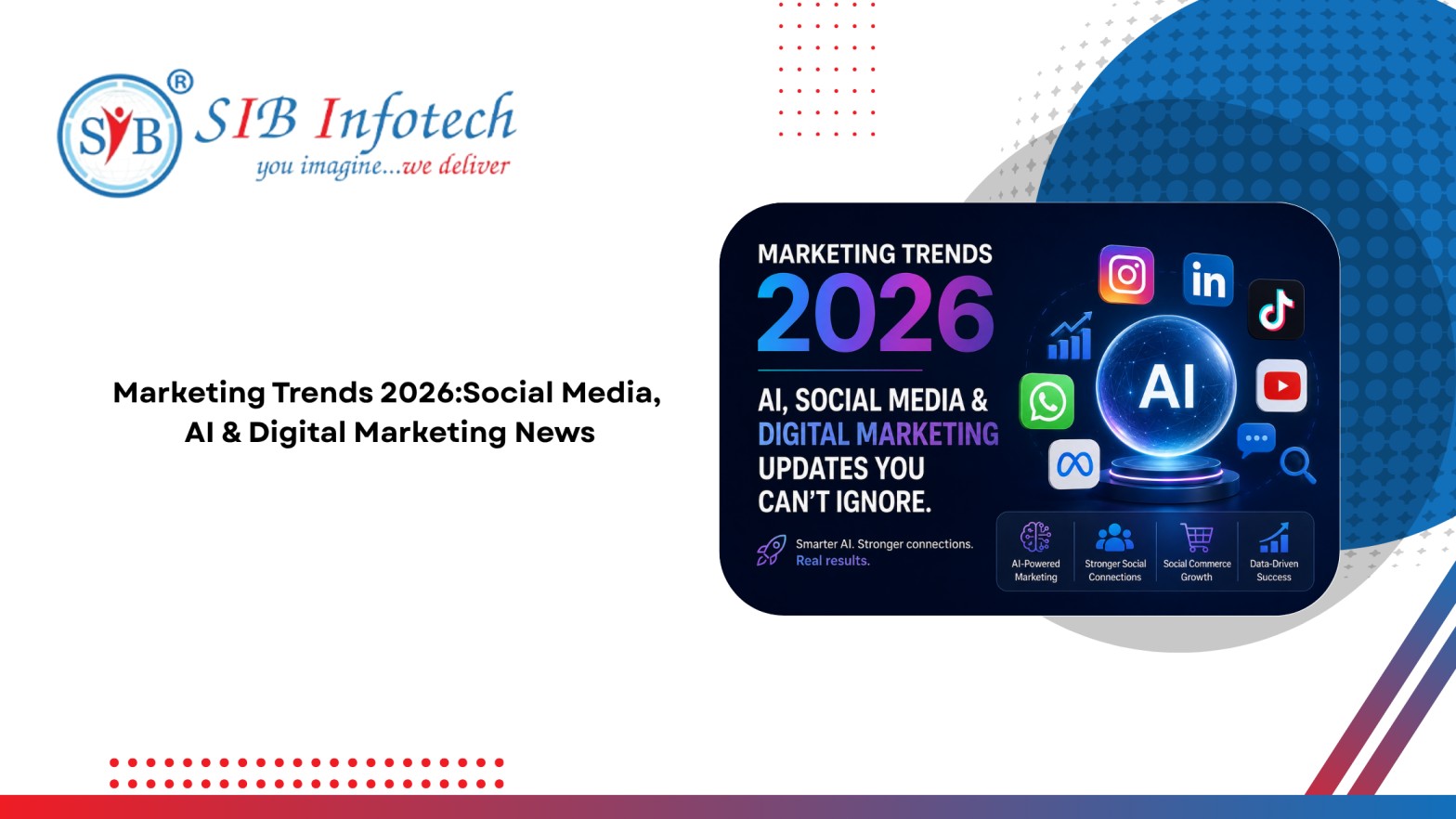
Google rebuilt its search bar around Gemini. Instagram started rewarding shares and saves over likes. LinkedIn quietly became the top B2B video platform. WhatsApp crossed 3 billion users. TikTok changed ownership. And AI moved from being a nice-to-have tool to the operating layer underneath almost every major platform.
Below are 50 real, researched updates across every major channel. Not predictions. Things that have actually happened, with data to back them up. Read the ones that apply to your channels first, then bookmark the rest.
At Google I/O 2026, Google announced the search interface is being rebuilt around Gemini 3.5 Flash. Users can now attach images, documents, Chrome tabs, and even videos directly to a search query. The results page slides between traditional links, AI Overviews, and full conversational AI Mode without leaving the page.
For marketers, this isn't just a UI refresh. Search is shifting from 'find information' to 'do things on my behalf.' Google demoed booking a karaoke room, monitoring apartment listings, and building a fitness tracker, all from a single search prompt. That changes what SEO means, and what content needs to do.
As of March 2026, AI Overviews appear on 48% of all Google queries, up from 34.5% in December 2025. That's a 58% increase in three months. (Source: Ahrefs)
Getting to page one on Google used to be the goal. In 2026, the goal is getting cited inside an AI Overview. Google's AI responses pull from multiple authoritative sources, and the brands that show up are the ones with structured, factual, clearly attributed content that reads like a trusted reference, not a keyword-stuffed blog post.
Marketers tracking impressions alongside clicks are finding a specific pattern: impressions rising while CTR falls. That gap almost always indicates an AI Overview is absorbing the traffic. Monitoring AI citation frequency in Semrush, Ahrefs, or BrightEdge is now a primary KPI alongside traditional rank tracking.
Google announced four new ad types at Google Marketing Live 2026, all generated dynamically by Gemini: Conversational Discovery Ads (contextual ads placed inside AI Mode answers), Highlighted Answers (sponsored entries inside AI recommendation lists), Business Agent for Leads (a Gemini-powered chatbot embedded directly inside the ad unit), and Direct Offers with native checkout.
They're still in beta and rolling out through 2026, but the direction is clear. Ad placements are moving inside AI responses, not just around them. Brands that wait until these go mainstream will already be behind.
A December 2025 report from 3Thinkrs found that 42% of UK and US B2B tech CMOs say declining performance from traditional search channels is pushing them to adapt specifically for generative engine optimization and zero-click search. GEO focuses on making content citation-worthy inside AI systems, structured data, named authorship, factual density, and entity clarity, not keyword density.
42% of B2B tech CMOs say AI is changing how their buyers discover and evaluate brands. (Source: 3Thinkrs, December 2025)
In May 2026, Meta expanded its AI business assistant to all advertisers. The tool automates parts of campaign setup, creative variation, audience suggestions, and performance diagnostics. For teams running Meta ads at scale, this changes how much time goes into execution versus strategy. It doesn't replace judgment, but it does compress the time between insight and action.
Announced at Google Marketing Live 2026, Ask Advisor lets marketers query Google Ads, Google Analytics 4, Merchant Center, and Google Marketing Platform from a single natural language prompt. Questions like 'which campaigns underperformed last week and what changed' now get answered in seconds inside the interface, no SQL, no Looker Studio rebuild needed.
Currently in English-only beta with more languages rolling out through 2026. Worth testing the moment it lands in your account.
Meta has officially started using interactions with Meta AI across Instagram and WhatsApp to inform ad targeting. When users ask Meta AI about their goals, interests, or product needs, that intent data is now used to serve more relevant ads. For marketers, intent signals are more real-time and more granular than anything available through traditional audience targeting. Ad creative that mirrors the questions users are already asking AI assistants will perform better than generic awareness messaging.
In January 2026, Instagram expanded its Marketing API, giving third-party platforms access to Reels skip rates, repost counts, and ad-driven profile visits. This closes a measurement gap that has frustrated brands for years. Now you can see not just how many people watched a Reel, but how many skipped it at the five-second mark.
Instagram head Adam Mosseri confirmed in early 2026 that shares and direct message sends are the strongest signals for content distribution, stronger than likes or comments. Posts that people share privately or save for later are being treated as genuine endorsements. Posts that rack up likes but get low shares are seeing reduced organic reach.
Content that earns shares and DM saves is being distributed to new audiences at a significantly higher rate than like-heavy posts. Adjust your content angle toward 'save this for later' rather than 'like if you agree.'
Reels now support embedded clickable links, letting creators and brands drive traffic directly from short-form video without the 'link in bio' workaround. This is a meaningful change for product launches, affiliate content, and any campaign where the ask is a specific click. Treat the Reel as the hook, and the link as the conversion point.
Instagram rolled out built-in translation across nine languages with automatic lip-syncing for video content. For brands targeting multiple markets, this removes a significant production barrier. A single creator video can now reach non-English speaking audiences without separate localized shoots, worth testing before paying for translated production.
Instagram confirmed that posts are now indexed for search in a way that makes caption keywords and hashtags directly relevant to discovery. If Instagram was just a 'reach' channel in your mix before, it's now also a search channel. Captions written with search intent, not just engagement hooks, will get broader distribution over time. Think of it as a lighter version of YouTube SEO, applied to social posts.
In March 2026, Instagram confirmed that users can reorder photos and videos in published carousel posts without deleting and reposting. Small change, real-world impact, especially for brands that catch an error after posting or want to test which slide order drives more swipes.
Instagram's standalone Edits app is being upgraded into what the company describes as a full in-house production tool. New additions include a built-in teleprompter for scripted Reels, AI-generated fonts, transform tools for repositioning elements, and multi-account management features. Teams relying on external editing apps now have a more integrated option.
Following a legal mandate requiring ByteDance to divest its US operations, TikTok USDS Joint Venture LLC, controlled by Oracle with investors Silver Lake and MGX, took operational control of TikTok in the US on January 22, 2026. The platform remains live and growing, but the ownership structure is fundamentally different. For brands with significant TikTok ad spend, understanding who controls the data is worth knowing.
In May 2026, TikTok launched a global commerce campaign explicitly positioning itself as the dominant discovery-to-purchase platform. The 'Watch It. Love It. Want It.' positioning puts a number around something marketers already suspected: discovery and purchase intent on TikTok are compressing. Users aren't just browsing, they're finding products and buying them in the same session. For e-commerce brands, TikTok Shop and shoppable content are no longer experiments.
TikTok for Business expanded its premium ad inventory in April 2026, introducing new formats designed to capture attention during high-cultural-relevance moments, trending sounds, viral content windows, and predictive trending placement. These formats cost more but offer first-mover access before content trends peak and CPMs climb.
TikTok announced an expansion of its Marketing Partners Program with a new Channel Sales Partner Program, broadening the ecosystem of agencies and tools that can offer TikTok advertising officially. For smaller agencies, this opens a more structured path to TikTok ad management that didn't exist before.
TikTok, Instagram Reels, and YouTube Shorts collectively generate more than 120 billion daily views. TikTok users alone spend an average of 55 minutes daily on the app. Short-form video is not a trend anymore, it's the default format for social content consumption, and brands without a repeatable process for producing it are ceding reach to competitors who do.
Short-form video accounts for 43% of all social media content consumed in 2026. Reels drive 22% higher engagement than other Instagram post types. (Source: NewMedia.com, 2026)
81% of businesses now name LinkedIn as their primary B2B video channel, while YouTube comes in at 76%. That's a 33 percentage point gain for LinkedIn in just two years. The reason isn't production quality, it's audience intent. LinkedIn's 1 billion professional members are actively evaluating vendors and researching solutions. YouTube's 2.7 billion users are mostly looking for entertainment or how-to content.
Native video posts on LinkedIn get up to 5x more engagement than static posts. Short-form vertical video earns 34% higher dwell time than square-format content. (Source: Wistia 2026 State of Video Report)
LinkedIn audience data for 2026 confirms that people follow people, not logos. Personal profiles, founders, sales leaders, subject matter experts, are outperforming company pages by a factor of eight on engagement. B2B brands getting the most out of LinkedIn are investing in employee personal brand development, not just company page content strategies.
In early 2026, LinkedIn launched Reserved Ads, letting brands secure the top-of-feed placement at a fixed rate rather than competing in an auction. For B2B launches, events, or time-sensitive campaigns, this removes the unpredictability of CPC bidding. Worth evaluating for high-stakes campaigns where consistent visibility matters more than CPM efficiency.
A March 2026 report confirmed LinkedIn posted 121% ROAS, outpacing Google and Meta and capturing 41% of paid social budgets among B2B marketers. For companies where the buyer is a professional decision-maker, LinkedIn's targeting by job title, seniority, company size, and industry remains uniquely precise in ways that Facebook's interest-based targeting can't replicate.
Meta announced it's broadening advertiser verification so that verified advertisers account for 90% of ad revenue by end of 2026, up from 70% currently. For legitimate brands, this is good news, it reduces competition from low-quality or fraudulent advertisers. The practical step: make sure your Business Manager verification is complete and current.
Meta's Advantage+ campaign structure, which uses AI to automatically manage audience targeting, bid strategies, and creative placement, is now the recommended setup for most campaign types. Advertisers switching to Advantage+ are reporting lower CPAs, but reduced visibility into exactly who their ads are reaching. The trade-off between performance and control is real, and it's not right for every brand or objective.
Meta reinforced originality as a distribution signal on Facebook in late March 2026. Content that's been recycled, watermarked from other platforms, or lightly modified from viral posts is being pushed down algorithmically. Brands running content aggregation strategies on Facebook are seeing organic reach declines. Original content, and original video in particular, is where the platform is directing distribution.
YouTube now has cross-generational penetration in the US from Gen Z (91%) through Baby Boomers (69%). Facebook leads on monthly active users (177.5 million US MAU vs. Instagram's 143.3 million), but YouTube's total reach across age groups is broader than any other single platform. For brands trying to reach multiple generations with a single platform strategy, YouTube is increasingly the answer.
A March 2026 eMarketer report found that social teams are rethinking YouTube as Shorts surges alongside both long-form and episodic content gaining traction. The old mental model of 'YouTube = long-form only' no longer holds. Brands treating YouTube as a single format are leaving reach on the table.
New Demand Gen features announced at Google I/O 2026 let brands pull creator partnership videos directly into the Google Ads asset picker, no downloading, re-uploading, or platform-switching. Creator content that lives on YouTube can now be amplified via paid Google campaigns in a single workflow.
WhatsApp reached 3 billion monthly active users worldwide in early 2026, projected to cross 3.5 billion by year-end. It operates in more than 180 countries and ranks as the third most-used social platform globally. India alone has 535 million active users, with projections of crossing 1 billion users in India by late 2026.
A 2026 Twilio Messaging Engagement Benchmark Report analyzing 4.8 billion WhatsApp messages found that WhatsApp's average open rate has held firm at 98.2%, compared to the global average email open rate of just 21.4%. Click-through rates on WhatsApp campaigns hit a median of 58.3%, with AI-personalized message sequences achieving up to 74.1% CTR, outperforming equivalent email campaigns by a factor of 6.8x.
WhatsApp click-through rates are running 6.8x higher than equivalent email campaigns on the same audience. (Source: Forrester Research & Infobip, 2026)
WhatsApp Business has passed 200 million monthly active users. 67% of consumers now prefer WhatsApp over email or phone for customer support. Brands using WhatsApp Business are seeing 27% higher sales and 225% faster response times compared to email-based support. For brands in India, Brazil, or any market where WhatsApp dominates messaging, this channel is table stakes, not a supplementary touchpoint.
The influencer marketing industry is projected to reach $24 billion, with worldwide ad spend hitting $35.09 billion. For every $1 spent, businesses are seeing an average return of $6.50. 70% of marketers plan to increase influencer marketing budgets this year, and 66% expect the channel to outpace organic search and email as a growth driver.
80.8% of marketers use Instagram for influencer marketing campaigns, but the shift is firmly toward smaller, more niche creators. Micro-influencers (10K–100K followers) are being chosen 10 times more often than mega-influencers, driven by higher engagement rates, lower costs, and more targeted audience alignment. 69% of consumers trust recommendations from influencers, and that trust tends to be higher with creators who feel more like peers than celebrities.
B2B brands are using LinkedIn creators at increasing rates, with a 35% increase in brand collaborations reported in 2026. The format is different from B2C influencer content, it skews toward thought leadership, data breakdowns, and professional opinion, but the mechanics are the same. A credible LinkedIn voice mentioning your product in a well-reasoned post drives awareness with an audience that's actively in buying mode.
As marketing budgets tighten, affiliate payment structures, where creators earn a percentage of sales they drive, are becoming more common than flat-fee deals. Brands that can't justify large per-post fees are finding that affiliate arrangements give access to larger creator networks at lower upfront costs. The trade-off: creators with large audiences are less likely to accept affiliate-only deals, so this model works better with mid-tier and micro creators.
55% of social media users are actively uncomfortable with AI-generated content, and 52% say they're concerned when brands post AI content without disclosing it. Raw, unpolished, creator-first formats are outperforming studio-quality AI-generated content in engagement on most platforms. The authenticity gap is real, and it's closing for brands that exploit it.
Brands are shifting toward serialized video content, recurring formats that give audiences a reason to come back. The two dominant structures: behind-the-scenes series showing real people behind the brand, and educational mini-series that build knowledge incrementally. Content series build habitual viewership in a way that individual viral posts can't.
A Content Marketing Institute report found that 45% of B2B marketers worldwide are prioritizing investment in AI-powered marketing tools for 2026. Use cases split into three categories: analysis and research, content creation (copy and captions, with human editing), and campaign optimization within Google, Meta, and TikTok ad systems.
Employee-generated content, posts, videos, and commentary from actual employees rather than corporate accounts, is seeing significantly higher engagement than equivalent branded content. It's authentic in the way that matters most to algorithms and audiences in 2026: it has a real face, a real name, and a real opinion. Brands that have built internal EGC programs are seeing organic reach that branded content can't buy.
Email marketing delivers the highest conversion rates of any digital channel in 2026, especially through triggered and lifecycle campaigns. But the channel is under pressure from rising consumer expectations. Batch-and-blast campaigns are underperforming sharply; personalized, behavior-triggered sequences are performing well. Brands still sending the same newsletter to their entire list are seeing declining engagement.
After years of being under-resourced, community management is getting renewed investment. Social media algorithms are increasingly rewarding content that generates real conversation and community activity. Brands with active comment sections, Discord servers, and niche group participation are getting organic distribution that purely broadcast-focused brands can't match.
Reddit's advertising business is accelerating, driven partly by the Reddit-Google AI deal that's improved Reddit's organic search visibility. Reddit ad spend is growing 46.3% YoY, more than double Instagram's growth rate and five times TikTok's. For brands targeting high-intent, research-mode consumers, Reddit's community structure lets you reach people at the exact moment they're evaluating a product category.
Social media is overtaking organic search as the primary traffic driver for e-commerce in several categories. In a 2026 survey of 300+ US small businesses, 64% cited social as their primary traffic driver, compared to 52% for organic search. 35% of businesses without a website said social media and marketplace platforms delivered enough leads that they didn't need one.
Live-stream shopping, dominant in China for years, is finally finding its footing in Western markets through TikTok LIVE, Instagram Live Shopping, and YouTube's live commerce integrations. The format combines entertainment with immediate purchase intent in a way that pre-recorded ads can't. For apparel, beauty, and consumer electronics brands, piloting live commerce before competitors do is a real first-mover opportunity right now.
X works for brands that treat it as a real-time opinion platform, not a broadcast channel. Brands posting daily commentary on industry news, with actual perspective, not just links, are seeing 20–35% follower growth annually. Contrarian takes and short native videos under 60 seconds are getting the most algorithmic boost.
Hootsuite's 2026 social trends report called out LinkedIn and Substack as two underexplored platforms for brands looking for more intentional ways to connect with audiences, outside the algorithmic noise of main feeds. Threads is growing as a text-first, conversation-forward space. Substack works for brands that can sustain a genuine editorial voice. Neither replaces Instagram or TikTok for reach, but both build a more durable direct relationship with audiences.
Pinterest drives outsized product discovery in specific categories: home decor, fashion, beauty, food, and travel. Pinterest users are in active purchase-planning mode, not just browsing. The platform's visual search and shoppable pins make it a direct-to-checkout discovery tool for the right audience. Most brands in these categories are underinvesting in it.
Third-party cookies are declining. Platform-level tracking is being restricted by Apple's App Tracking Transparency, European privacy regulations, and growing consumer opt-out rates. Brands with strong first-party data, email lists, CRM data, loyalty programs, owned community data, are maintaining targeting precision while brands dependent on third-party data are seeing ad efficiency erode. Building first-party data collection into every customer touchpoint is a present priority, not a future one.
Brand trust used to be a soft metric. In 2026, it's being measured alongside performance metrics. Brands building authority through consistent content, named expertise, and clear positioning are seeing compounding advantages in organic reach, AI citation frequency, and paid ad efficiency. Platforms are rewarding trusted brands with lower CPMs, better organic distribution, and more prominent placement in AI-generated responses.