
• May 12, 2026

Google Removes FAQ Rich Results Test from Search Console: What It Means for SEO in 2026

Rich Results Test in Google Search Console 

Home Blog Google Removes FAQ Rich Results Test from Search Console: What It Means for SEO in 2026

Rich Results Test in Google Search Console 

About The Author

Anuj Bajaj

Anuj Bajaj

Anuj Bajaj is the Co-Founder of SIB Infotech and a seasoned digital strategist with over 18 years of experience in website development, SEO, and performance marketing. He leads the agency’s content and digital growth initiatives, ensuring that every piece of content is both search-engine optimized and value-driven. Anuj believes in blending AI-powered efficiency with human creativity to deliver content that educates, converts, and builds authority.

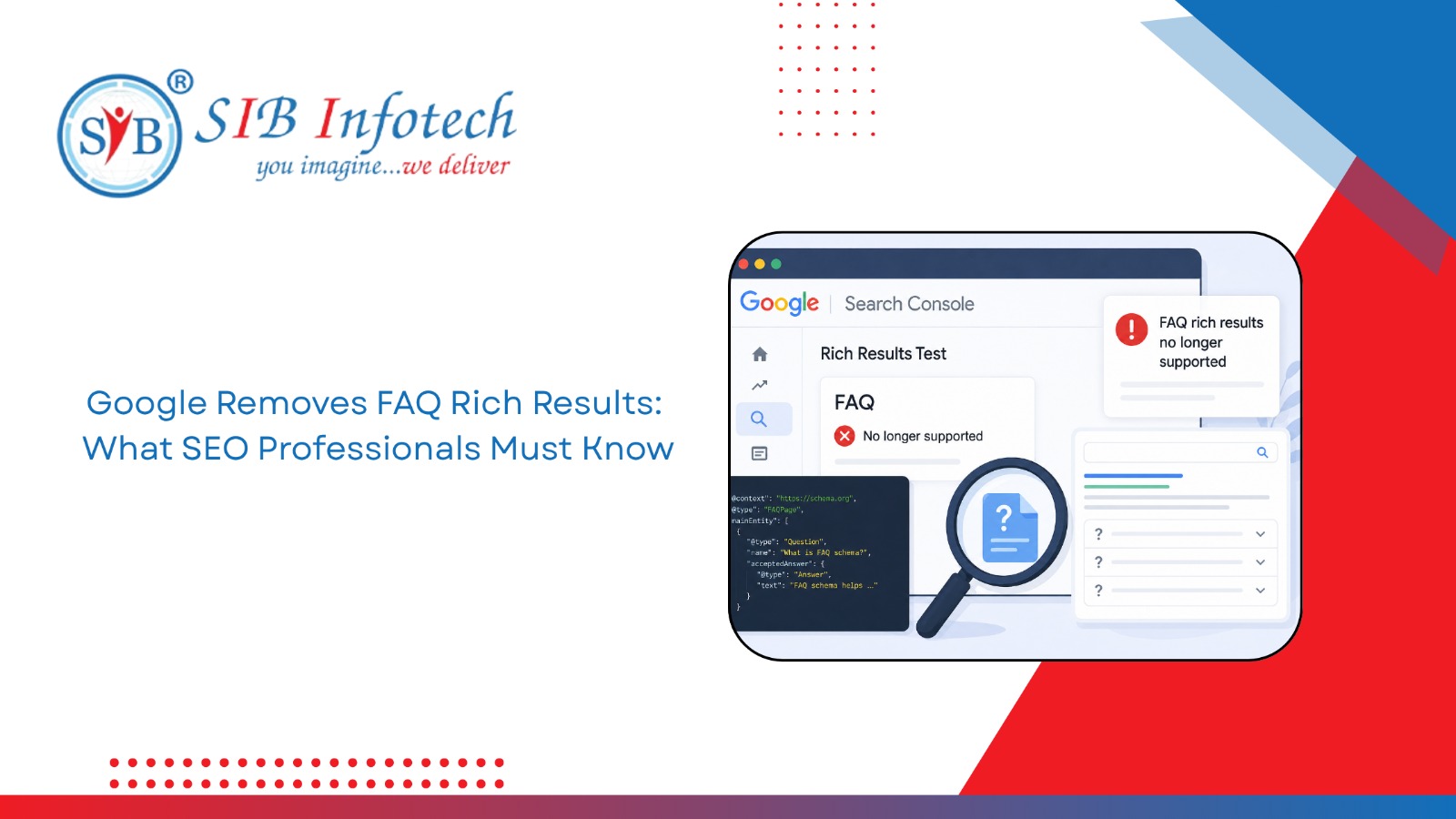
Google keeps updating its search experience to improve how users find information online. Over the last few years, we have seen major changes in structured data, AI-driven search results, and search visibility. Now, another important update has started getting attention in the SEO industry. Google has officially removed FAQ rich result support from several areas, including reporting changes connected to the rich results test - google search console system.

For many SEO professionals, publishers, businesses, and website owners, this update has raised several questions. Will FAQ schema still matter? Does structured data still help SEO? Should businesses remove FAQ markup from their websites? And most importantly, how will this affect rankings and visibility in search results?

The removal of FAQ rich results does not mean structured data is dead. Instead, it signals a bigger shift in how Google wants websites to focus more on useful content and less on excessive SERP enhancements. Earlier, many websites relied heavily on FAQ snippets to occupy more space in search results and improve click-through rates. But now, Google appears to be reducing visual clutter and prioritizing cleaner search experiences.

This latest google search console update also reflects how search is evolving toward AI-powered understanding rather than relying only on traditional schema markup. Businesses and marketers now need to rethink how they use structured data and what actually contributes to long-term SEO success.

In this blog, we will explain what changed, why Google removed FAQ rich results, whether structured data still helps SEO, and what businesses should focus on moving forward.


What Is the Rich Results Test in Google Search Console?


The rich results test - google search console tool is designed to help website owners check whether their structured data is properly implemented and eligible for enhanced search results. Structured data helps Google understand webpage content more clearly using schema markup.

Rich results are enhanced search listings that can include:

  • FAQs

  • Reviews

  • Product information

  • Ratings

  • Breadcrumbs

  • Recipes

  • Articles

  • Local business details

These rich results often make search listings more visually attractive and informative, helping websites improve click-through rates.

The Rich Results Test became an essential part of technical SEO because it allowed businesses and SEO professionals to validate whether their schema markup was working correctly. If Google detected errors in structured data, website owners could fix them before search engines crawled the page again.

Over time, FAQ schema became one of the most widely used structured data types because it allowed websites to show expandable question-and-answer sections directly in Google Search results.

This offered several benefits:

  • Increased search visibility

  • More SERP space

  • Better user engagement

  • Higher click-through rates

  • Improved content organization

Because of these advantages, many websites started overusing FAQ schema, even on pages where it added little value to users.

That overuse eventually contributed to Google changing how FAQ rich results are displayed and reported.


What Are FAQ Rich Results?

FAQ rich results are enhanced search listings that display questions and answers directly below a webpage result in Google Search. These results are created using faq structured data added to webpage code.

For example, if a website has a frequently asked questions section, Google may show those questions directly in search results. Users can expand the answers without even visiting the website.

This feature became popular because it helped websites:

  • Take more space in search results

  • Improve search visibility

  • Answer user questions quickly

  • Increase organic CTR

  • Improve mobile search appearance

The technology behind FAQ rich results is called "FAQ schema markup," which refers to structured data added using schema.org vocabulary.

FAQ schema is usually implemented in JSON-LD format and helps search engines understand that the content contains questions and answers.

Industries that heavily used FAQ schema included:

  • Ecommerce websites

  • SEO blogs

  • Service-based businesses

  • Healthcare websites

  • Finance websites

  • SaaS companies

  • Affiliate blogs

However, Google noticed that many websites were adding FAQ sections mainly to gain extra SERP space rather than genuinely helping users.

As a result, Google gradually started limiting FAQ rich results before eventually removing broad support.


Google Removes FAQ Rich Results: What Actually Changed?


Google first started reducing FAQ rich results visibility in 2023. Initially, FAQ rich snippets became limited mainly to authoritative government and health websites. Over time, support continued decreasing across normal websites.

Now, Google has made bigger changes connected to the rich results test - google search console ecosystem.

Google has officially confirmed that FAQ rich results are being deprecated across Search. According to Google’s official FAQ structured data documentation, FAQ rich results are no longer broadly appearing in Google Search, and support for FAQ reporting inside Rich Results Test and Search Console APIs will also be removed gradually through 2026. 

The major changes include:

  • FAQ rich results are no longer broadly supported

  • FAQ enhancement reporting in Search Console is being removed

  • FAQ support inside Rich Results Test tools is ending

  • Some API support connected to FAQ reporting is also being discontinued

This means website owners may no longer see FAQ-related enhancement reports like before.

Google’s decision appears to be based on improving search quality and reducing spammy implementations of FAQ schema.

Earlier, many websites added unnecessary FAQ sections simply to dominate search results visually. In some cases, websites repeated obvious questions that added little informational value.

Google now wants search results to remain cleaner, more useful, and less cluttered.

Another major reason behind this shift is the rise of AI-driven search experiences. Google increasingly relies on semantic understanding, contextual analysis, and AI-generated summaries instead of depending heavily on visible schema enhancements.

This update does not mean structured data has become useless. Instead, Google is becoming more selective about which rich results it wants to display prominently.


Why Google Removed FAQ Rich Results From Search Results

One of the biggest reasons behind this update is over-optimization.

Many websites started using FAQ schema aggressively even when the content did not genuinely require it. Instead of improving user experience, some websites used FAQ sections mainly for visibility manipulation.

Common issues Google likely observed included:

  • Repetitive FAQ content

  • Low-value questions

  • Keyword stuffing inside FAQs

  • Irrelevant schema usage

  • Duplicate information

  • SERP clutter

Google has repeatedly emphasized that structured data should help users understand content better rather than manipulate search visibility.

The company is also moving toward AI-powered search systems where search engines can interpret content meaning without relying entirely on markup.

The growing influence of AI Overviews and semantic search indicates that Google is focusing more on the following:

  • Contextual relevance

  • Helpful content

  • Expertise

  • Entity understanding

  • User intent satisfaction

Instead of rewarding websites simply for adding schema markup, Google now appears more interested in whether the actual content provides value.

This change also aligns with Google’s broader effort to improve content quality across search results.


Does Structured Data Help SEO in 2026?

One of the most common questions after this update is, "Does structured data help SEO?"

The short answer is yes.

Even though FAQ rich results are being reduced, structured data still plays an important role in SEO and search engine understanding.

However, it is important to understand one thing clearly:

Structured data is not a direct ranking factor.

Adding schema markup alone will not automatically improve rankings. But structured data can indirectly help SEO in several important ways.


How Structured Data Helps SEO


1. Improves Search Engine Understanding

Structured data helps Google understand webpage content more accurately. It provides additional context about products, reviews, articles, organizations, services, and businesses.

This can improve indexing and content categorization.

2. Supports Rich Results Eligibility

Although FAQ rich results are declining, many other rich result types still exist, including:

  • Product snippets

  • Review snippets

  • Breadcrumbs

  • Local business information

  • Recipe snippets

  • Article enhancements

These features can improve visibility in search results.

3. Enhances Click-Through Rates

Rich results often attract more user attention compared to standard search listings. Better visual presentation can increase CTR even without higher rankings.

4. Helps AI Search Systems

Modern search engines increasingly rely on entities, relationships, and semantic understanding. Structured data helps AI systems understand content structure and relevance more effectively.

5. Improves Local SEO

Schema markup for local businesses helps Google understand business information such as:

  • Address

  • Phone number

  • Operating hours

  • Services

  • Reviews

This remains valuable for local search visibility.

6. Supports Voice Search

Voice assistants often rely on structured data to deliver direct answers and contextual information.

So while FAQ snippets may be disappearing, structured data itself is still highly relevant.

The key difference is that businesses should now focus on quality implementations instead of excessive schema usage


What Is FAQ Schema Markup & Should You Still Use It?

Many website owners are now asking, "What is faq schema markup?" and "Should it still be used after Google’s update?"

FAQ schema markup is a type of structured data that tells search engines a webpage contains frequently asked questions and answers.

This markup is usually added using JSON-LD code format.

Even though FAQ rich snippets are no longer widely shown, FAQ schema can still provide value in several ways.

Why FAQ Schema Still Matters

Better Content Organization

FAQ sections help structure information clearly for users.

Improved User Experience

Visitors often appreciate quick answers to common questions.

Semantic Understanding

Google can still use FAQ markup to better understand webpage content even if the snippets are not displayed visually.

Helpful for AI Systems

AI-driven search systems may still use structured content to understand topics and relationships.

When You Should Still Use FAQ Schema

FAQ schema still makes sense when:

  • Questions genuinely help users

  • Content answers real search intent

  • FAQs improve readability

  • The section adds informational value

When You Should Avoid It

Avoid adding FAQ schema:

  • Only for SEO manipulation

  • On irrelevant pages

  • With repetitive questions

  • With keyword-stuffed answers

The goal should now be quality over quantity.


How This Google Search Console Update Affects SEO

This latest google search console update affects websites in several ways.

The biggest impact is reduced visual dominance in search results. Earlier, FAQ rich snippets allowed websites to occupy more screen space. Without those snippets, some websites may notice lower click-through rates.

Websites most likely affected include:

  • SEO blogs

  • Affiliate websites

  • Ecommerce stores

  • Publishers

  • Service-based businesses

Another challenge is reporting visibility.

Earlier, Search Console provided dedicated enhancement reports related to FAQ structured data. These reports helped website owners monitor schema implementation and errors.

Now, tracking FAQ performance becomes more limited.

This means businesses may need to rely more on:

  • Organic traffic monitoring

  • CTR analysis

  • Search performance reports

  • User engagement metrics

The update also reinforces the growing importance of content quality and topical authority.

Websites that relied heavily on visual SERP tricks may struggle more compared to websites focused on genuinely useful content.


What SEOs Should Focus on Instead in 2026


As search evolves, SEO strategies also need to evolve.

Instead of depending heavily on FAQ snippets, SEO professionals should focus on long-term ranking factors and user-focused optimization.

Key Areas to Focus On

Helpful Content

Google increasingly rewards content that solves real user problems.

Search Intent Optimization

Understanding why users search for something matters more than stuffing keywords.

Topical Authority

Publishing deep, interconnected content around specific topics improves authority.

AI Search Optimization

Search engines are moving toward AI-generated summaries and semantic understanding.

E-E-A-T Signals

Experience, Expertise, Authoritativeness, and Trustworthiness remain important.

Entity SEO

Google now understands relationships between topics, brands, products, and concepts more effectively.

User Experience

Page speed, readability, navigation, and mobile experience continue to influence performance.

Businesses should now focus on creating content that genuinely helps users instead of relying on schema tricks for visibility.


Structured Data Types That Still Matter in 2026

Although FAQ rich results are declining, many structured data types still remain highly valuable.

Product Schema

Helps display:

  • Pricing

  • Availability

  • Ratings

  • Product information

Very useful for ecommerce SEO.

Review Schema

Can improve trust and visibility for products and services.

Organization Schema

Helps search engines understand company information and branding.

Breadcrumb Schema

Improves navigation understanding and search appearance.

Article Schema

Useful for blogs, publishers, and news websites.

Local Business Schema

Important for local SEO and Google Business visibility.

These schema types continue supporting better search understanding and richer user experiences.


Best Practices for Using Structured Data After Google’s Update

After this update, businesses should use structured data more strategically. Follow this for best practices: 

Use Schema Only Where Relevant

Avoid adding markup unnecessarily.

Match Visible Content

Structured data should accurately reflect visible page content.

Avoid Spammy Implementations

Do not overload pages with repetitive FAQs.

Focus on User Intent

Create content that genuinely answers user questions.

Validate Markup Regularly

Use tools to check for schema errors and warnings.

Keep Content Updated

Outdated information reduces content trustworthiness.

Prioritize Helpful Information

Google increasingly rewards useful and trustworthy content.

The future of SEO is shifting toward semantic understanding rather than aggressive SERP manipulation.


The Future of Rich Results & AI Search

Search is changing rapidly because of AI.

Google now uses advanced AI systems to understand the following:

  • User intent

  • Context

  • Entities

  • Relationships

  • Search behavior

AI Overviews are becoming more common, and search engines increasingly generate summarized answers directly in results.

This means traditional SEO tactics alone may no longer be enough.

Structured data still matters because it helps search engines understand webpage context, but content quality is becoming even more important.

Businesses that focus on the following:

  • expertise

  • trust

  • useful information

  • semantic optimization

  • user satisfaction

will have stronger long-term SEO performance.


Conclusion

The removal of FAQ rich results marks another major shift in how Google handles structured data and search visibility. While many businesses relied heavily on FAQ snippets for higher click-through rates and extra SERP space, Google is clearly moving toward cleaner and more AI-driven search experiences.

The changes connected to the rich results test - google search console ecosystem may initially feel concerning for marketers and SEO professionals. However, this does not mean structured data has lost its importance.

As we discussed earlier, does structured data help SEO? Absolutely. Structured data still helps search engines understand content, improve indexing, support rich result eligibility, and strengthen semantic understanding.

The biggest takeaway from this update is simple:

SEO success in 2026 will depend more on helpful content, topical authority, semantic relevance, and user experience rather than excessive schema usage.

Businesses should continue using structured data strategically while focusing primarily on delivering real value to users.


Stay Updated With Google SEO Changes

Google Search and Search Console updates continue to shape how websites perform in organic search. From structured data changes to AI-driven search experiences, businesses need to adapt their SEO strategies to maintain visibility and rankings.

As a leading digital marketing agency in India, SIB Infotech helps businesses improve technical SEO, structured data implementation, content optimization, and overall search performance through result-driven SEO strategies.