
• Apr 30, 2026

Generative Engine Optimization Best Practices: How to Get Found in the Age of AI

generative engine optimization best practices guide for AI Search

Home Blog Generative Engine Optimization Best Practices: How to Get Found in the Age of AI

generative engine optimization best practices guide for AI Search

About The Author

Anuj Bajaj

Anuj Bajaj

Anuj Bajaj is the Co-Founder of SIB Infotech and a seasoned digital strategist with over 18 years of experience in website development, SEO, and performance marketing. He leads the agency’s content and digital growth initiatives, ensuring that every piece of content is both search-engine optimized and value-driven. Anuj believes in blending AI-powered efficiency with human creativity to deliver content that educates, converts, and builds authority.

Your website ranks on Google. You have done the keyword research, built the backlinks, and watched your positions climb. But here is a question that probably keeps you up at night: when someone asks ChatGPT to recommend a business like yours, does your name ever come up?

For most business owners right now, the honest answer is no.

Search behavior has shifted fundamentally over the past eighteen months. People are no longer typing queries into Google and scrolling through ten blue links the way they used to. Instead, they are opening ChatGPT, Gemini, or Perplexity, asking a complete question in plain conversational language, and walking away with a fully formed AI-generated answer. No clicking. No scrolling. No visiting your website at all unless the AI decides to cite you.

This shift represents a major evolution of SEO with generative AI one that every business owner needs to understand. Similarly, the generative AI impact on SEO is already visible in declining click-through rates and changing search behavior patterns.

But first, what actually is this GEO thing everyone is suddenly talking about?

What Does GEO Stand For and Why Should You Care?

Let us start with the obvious question: What does GEO stand for?

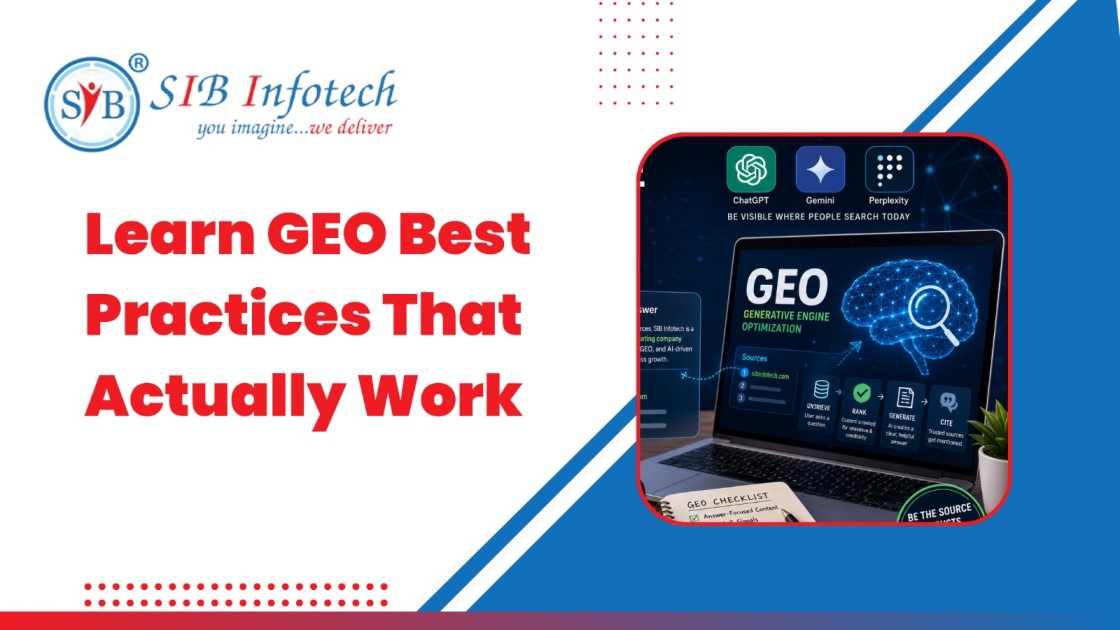
GEO stands for Generative Engine Optimization. In plain, jargon-free language, it is the practice of optimizing your content so that AI-powered search tools like ChatGPT, Google Gemini, and Perplexity choose to cite your brand when they generate answers to user questions.

One of the key generative engine optimization features is its focus on conversational query matching rather than keyword matching. Unlike traditional SEO, another important generative engine optimization feature is that GEO prioritizes answer clarity and source authority over keyword density.

Unlike traditional SEO, which focuses on helping a human find your website through a search engine results page, GEO focuses on helping an AI find your content so that the AI then presents it to a human as part of a generated answer.

Why should you care? Because the way people find information has changed permanently.

Think about your own behavior over the past year. When you need a quick answer, do you still type a query into Google and click through three different websites to piece together the information? Or do you just ask ChatGPT and get everything in one clean paragraph?

Most people are doing the latter.

Generative engines are now the first stop for millions of users looking for recommendations, explanations, comparisons, and answers. If your content is not being cited by these AIs, you are invisible to an entire and rapidly growing audience. Ignoring GEO today is the same mistake as ignoring SEO back in 2005, except this time, the shift is happening ten times faster.

So now that you understand what GEO is, the natural next question is, how does a generative engine actually decide what to show?

How Generative Engines Work to Serve Information

To understand how a generative engine works to serve information, you need to peek behind the curtain at what actually happens when someone asks ChatGPT or Gemini a question.

The process is not magic, although it can feel that way.

When a user types a question into a generative engine, the AI does not simply pull an answer from nowhere. It processes the query, retrieves relevant information from its training data and from real-time sources where available, ranks that information for relevance and credibility, and then assembles it into a coherent, conversational response.

Here is what matters for your business: the AI is constantly making decisions about which sources to trust and which to ignore.

Generative engines favor content that has three key characteristics. First, clarity: the content must answer the question directly and immediately without forcing the AI to hunt for the answer. Second, authority: the content must come from a source that has demonstrated expertise and trustworthiness. Third, structure: the content must be organized in a way that the AI can easily parse, with clear headings, logical flow, and direct statements of fact.

What does not work? Traditional keyword-first content strategy where you stuff variations of a phrase into a bloated paragraph and hope for the best. Generative engines are trained on human conversation, not on keyword density. They reward content that actually answers questions and penalize content that tries to game the system.

Now that you understand how GEO works, you are probably wondering, how is this any different from the SEO What am I already doing?

What Is the Difference Between GEO and SEO?

This is where GEO vs SEO becomes a critical distinction to understand.

When examining answer engine optimization vs generative engine optimization, it is important to note that AEO focuses on position zero snippets while GEO focuses on multi-sentence AI citations. Understanding answer engine optimization vs generative engine optimization helps you allocate resources correctly between these two emerging disciplines.

Here is a side-by-side comparison that makes the distinction clear:

Dimension SEO AEO (Answer Engine Optimization) GEO (Generative Engine Optimization)
Primary Intent Drive traffic to the website. Get featured in voice/search answers Get cited in AI-generated responses
Target Platform Google, Bing, Yahoo Voice assistants, featured snippets ChatGPT, Gemini, Perplexity
Content Format Pages, posts, product listings Direct answers, FAQ blocks Conversational Q&A, structured data
Success Metric Rankings, organic traffic, CTR Position zero, answer presence AI citation frequency, brand mentions
Optimization & Focus Keywords, backlinks, technical SEO Question matching, concise answers Authority, conversational clarity, E-E-A-T

And to address a common point of confusion, are answer engine optimization and generative engine optimization the same?

No, they are not the same, although they are related. AEO focuses on getting your content featured in direct answer boxes on traditional search engines (the "position zero" snippets you see on Google) and in voice assistant responses. GEO focuses on getting your content cited within the multi-sentence, conversational answers generated by AI tools like ChatGPT. AEO answers a specific question in a sentence or two. GEO provides the source material that an AI uses to build a paragraph or more of explanation.

Both matter. But for the world we are entering, GEO is where the real opportunity lies.

Now, this comparison might have created a small panic in your head. Does this mean you have to throw out your entire SEO strategy and start over? Absolutely not. Let us explain why.

Can SEO and GEO Strategies Work Together?

The question every smart business owner asks at this point is, can SEO and GEO strategies work together for better results?

The answer is a firm yes. In fact, they do not just work together. They need each other.

GEO is not here to replace SEO. That would be like saying a new restaurant across the street replaces your existing one. Both serve different parts of the customer journey, and both are required for full digital visibility.

Here is how the two strategies complement each other.

A well-structured SEO foundation makes your GEO efforts stronger. Domain authority, quality backlinks, content depth, technical performance all of these traditional SEO factors feed directly into how generative engines assess your credibility. If your website has weak SEO signals, generative engines will treat your content as less trustworthy.

Conversely, strong GEO performance can boost your traditional SEO. When generative engines cite your brand frequently, that creates brand awareness, drives referral traffic, and signals relevance that traditional search engines also notice.

The generative AI impact on SEO is profound from reduced click-through rates to the need for conversational content optimization. Similarly, the evolution of SEO with generative AI means that SEO professionals must now think about AI citations alongside traditional rankings.

The generative AI SEO strategies that work best are the ones that serve both masters simultaneously. These generative AI SEO strategies include creating content structured for traditional crawlers but written conversationally for AI consumption. Build authority through third-party citations that both Google and ChatGPT respect. Optimize for featured snippets while also optimizing for AI citations.

Now that you understand what GEO is and how it sits alongside SEO, here is exactly what you need to do to make it work.

Generative Engine Optimization Best Practices

This is the core of the guide, the generative engine optimization best practices that separate brands that get cited from brands that get ignored.

  • 1: Lead every page and article with a direct, clear answer

    Generative engines consistently favor content that gets to the point immediately. If a user asks "What is GEO?" and your article spends three paragraphs on history before defining the term, the AI will likely skip you for a source that answers in the first sentence.

    Put the answer first. Explain later.

  • 2: Write in natural, conversational language

    AI engines are trained on human conversation, not on corporate copywriting or academic papers. Write the way your customers actually speak. Use contractions. Ask rhetorical questions. Keep sentences short. The more natural your content sounds when read aloud, the more likely a generative engine is to trust and cite it.

  • 3: Build strong E-E-A-T signals across your website

    Experience, Expertise, Authority and Trust are the four pillars that generative engines use to decide whose content is worth citing. Show your credentials. Display author bios. Link to verifiable external sources. Get mentioned on reputable industry platforms. Every E-E-A-T signal you build makes your content more citeable.

  • 4: Create dedicated FAQ and Q&A content

    Map the real questions your audience types into ChatGPT, Gemini, and Perplexity every day. Then create content that answers those questions directly and completely. FAQ pages, Q&A sections, and "what is" explainers are gold for GEO because they match exactly how users interact with generative engines.

  • 5: Earn citations on authoritative third-party platforms

    Generative engines do not just look at your website. They look at who else is talking about you. Press features, industry directories, guest posts on reputable sites, and digital PR all signal credibility to AI engines. Every authoritative mention of your brand increases the likelihood that a generative engine will cite you.

  • 6: Refresh your content regularly with updated data

    AI engines favor recency. Content that was last updated three years ago signals neglect. Content that was updated last week signals active relevance. Go back through your existing content regularly, add new data, update old examples, and refresh statistics. Then mark the content as updated.

  • 7: Use a clean, logical content structure

    Generative engines parse structured content far more effectively than dense, unbroken blocks of text. Use clear H2s and H3s. Keep paragraphs short — three to four sentences maximum. Use bulleted lists where appropriate. Think of your content as something both a human and an AI need to be able to scan and understand quickly.

  • 8: Add original data and expert quotes

    Original research, proprietary statistics, and genuine expert quotes are the elements that make AI engines more likely to cite your piece over a generic competitor article. If you have unique data, feature it prominently. If you can quote an industry expert, do so. Originality signals authority.

  • 9: Optimize for featured snippets and passage indexing

    The formats that work for Google's featured snippets align closely with what generative engines need to extract and present information. Clear question-headline pairs. Direct answers followed by explanation. Short, standalone passages that answer one specific thing. Optimize for snippets, and you largely optimize for GEO.

  • 10: Implement schema markup across your key pages

    Structured data gives generative engines direct, machine-readable signals about who you are, what you do, and why you are credible. FAQ schema, HowTo schema, Organization schema, Article schema, these all help AIs understand your content without having to infer meaning from text alone.

Ready to put these best practices into action? SIB Infotech's GEO services are designed specifically for Indian SMEs who want to get cited by AI. Our team can help you implement every practice outlined above — from content optimization to schema markup to authority building.

Now, knowing the best practices is one thing. But how do you actually put all of this together into a real strategy? Here is your step-by-step plan.

How to Build a GEO Strategy From Scratch

Building a GEO strategy does not require magic. It requires methodical execution. Here is exactly how to build a GEO strategy from scratch.

  • Step 1: Run a full audit of your existing content

    Before you build anything new, understand what you already have. Assess your current content for answer clarity. Does each page answer its primary question in the first paragraph? Assess structure: Is your content organized with clear headings and short paragraphs? Assess E-E-A-T: does your content signal expertise and authority? This audit gives you your starting point.

  • Step 2: Research the questions your audience is asking AI tools

    Go to ChatGPT, Gemini, and Perplexity yourself. Type in questions related to your business. See what answers come back and which sources get cited. Use tools like AnswerThePublic, AlsoAsked, and Perplexity's own discovery features to map the exact conversational queries your target audience is using in your niche.

  • Step 3: Match your content to those questions

    Every key page on your website should answer at least one high-intent conversational query completely and clearly. Create a spreadsheet. List the questions on one side. Map your existing and planned content to each question. Where there are gaps, those are your content creation priorities.

  • Step 4: Build genuine topical authority across your niche

    Generative engines favour depth over breadth. Do not try to cover every topic superficially. Instead, build a connected ecosystem of content that covers your specific subject area with depth, consistency, and original insight. A cluster of ten deeply related articles on one topic will outperform fifty scattered articles every time.

  • Step 5: Set up tracking and measurement from day one

    You cannot improve what you do not measure. Establish a baseline for your current AI citations. Monitor how often your brand appears in responses on ChatGPT, Gemini, and Perplexity. Track your brand mention share relative to competitors. Set up systems to catch when you gain or lose citations. More on this in the next section.

But which tools do you actually use to track all of this? And how do you know if your GEO efforts are working? Let us get into exactly that.

Generative Engine Optimization Tools and How to Measure Success

You have implemented the best practices. You have built your strategy. Now you need to know how to measure the success of generative engine optimization campaigns.

The short answer is that you measure what gets cited, how often, and by which AI platforms.

Here are the key generative engine optimization tools that help you track your GEO visibility. These GEO tools range from dedicated AI citation trackers to traditional SEO platforms with GEO applications.

Tool Purpose Best For
Brand24 Monitor AI citations and brand mentions across ChatGPT and other platforms Tracking when your brand appears in AI responses
Frase.io Analyze content for answer clarity and GEO readiness Optimizing existing content for AI citation
Perplexity Pro Test how your brand appears in Perplexity responses Direct measurement on one major AI platform
Zapier AI Citations Track and log AI mentions automatically Automated citation monitoring across multiple AIs
Google Search Console Monitor featured snippets and question matches Connecting traditional snippet performance to GEO

Track these metrics monthly. Watch for trends. When citations drop, audit your content freshness. When competitors overtake you, study what they are doing differently. Now, you have the tools, the strategy, and the best practices. But where is all of this heading?

What Is the Future of SEO in Generative Search?

Over the next three to five years, generative search will move from novelty to norm. The percentage of searches that begin on ChatGPT or Gemini rather than Google will continue to climb. Younger users, in particular, will default to AI tools for answers, recommendations, and research.

The generative AI impact on SEO will only intensify as more users shift to AI-first search behaviors. This evolution of SEO with generative AI represents the most significant change in digital marketing since Google's original algorithm updates.

For businesses, this means one thing: visibility will bifurcate. Brands that invest early in generative engine optimization best practices will dominate AI citations and capture the attention of AI-first users. Brands that ignore GEO will find themselves invisible in the channels where their customers are increasingly spending time.

Here is the good news. GEO and SEO are long-term partners, not competitors. The businesses that run both in sync, using SEO to build authority and structure and using GEO to ensure that authority gets cited by AI, will dominate both traditional and AI-powered search.

The question is not whether generative search is coming. It is already here. The question is whether your brand will be part of the answer when customers ask.

Frequently Asked Questions