
• Apr 28, 2026

Tired of Slow SEO Results? Try These Agentic AI Tools in 2026 Image Link:

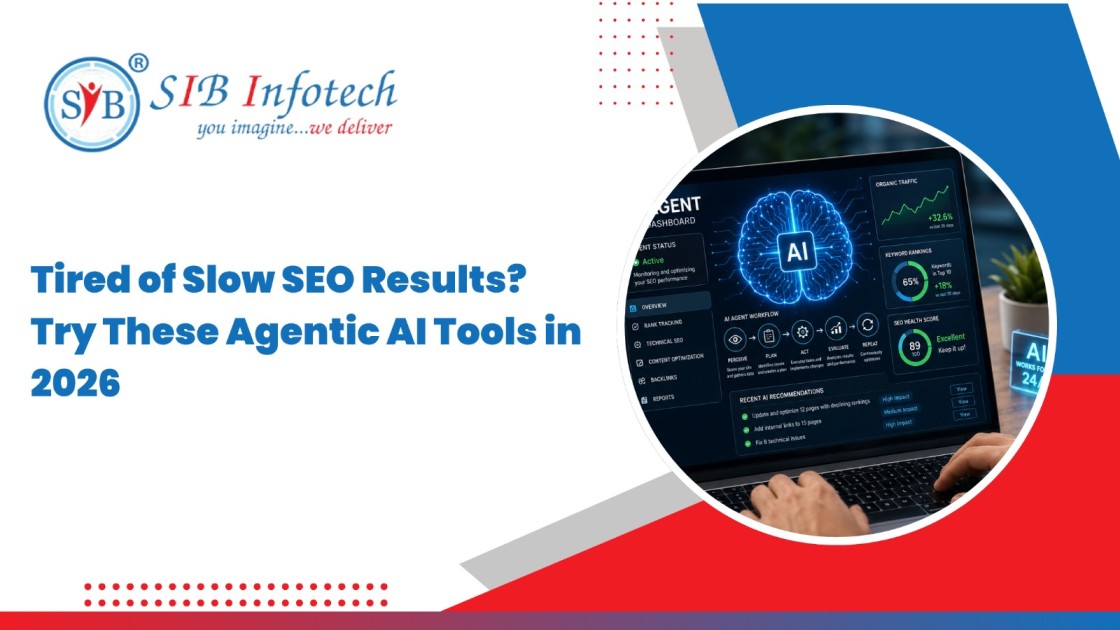
Laptop screen showing agentic AI tools with a digital AI brain interface in use for SEO.

Home Blog Tired of Slow SEO Results? Try These Agentic AI Tools in 2026 Image Link:

Laptop screen showing agentic AI tools with a digital AI brain interface in use for SEO.

About The Author

Anuj Bajaj

Anuj Bajaj

Anuj Bajaj is the Co-Founder of SIB Infotech and a seasoned digital strategist with over 18 years of experience in website development, SEO, and performance marketing. He leads the agency’s content and digital growth initiatives, ensuring that every piece of content is both search-engine optimized and value-driven. Anuj believes in blending AI-powered efficiency with human creativity to deliver content that educates, converts, and builds authority.

You are publishing content. You are fixing technical issues. You are doing everything the SEO guides tell you to do. And yet the rankings are not moving fast enough.

If that sounds familiar, you are not alone. Most businesses hit this wall at some point, not because their SEO strategy is wrong, but because the way they are executing it simply cannot keep up with how fast search is evolving.

In 2026, the businesses that are seeing real SEO momentum are not necessarily the ones with bigger teams or bigger budgets. They are the ones using smarter tools specifically, agentic AI tools that plan, act, and optimize on their own without waiting for someone to press a button.

This blog covers the best tools available, what they do, and how to pick the right one for your business.

What Are Agentic AI Tools?

Most AI tools you have come across so far are reactive. You type a prompt, you get a response. The tool does nothing until you give it the next instruction.

These tools work differently. These tools can independently set sub-goals, decide what steps to take, carry out those steps, review the results, and adjust, all without waiting for you to guide them at every stage.

The simplest way to think about it: a standard AI tool is like a calculator. You put in an input, you get an output. An agentic AI is more like a junior team member you brief once.

You say: "Improve the SEO performance of our service pages." They go away, research the problem, build a plan, execute tasks, and come back with results, without you holding their hand through every step.

That shift from reactive to self-directed is what makes these tools a genuine game-changer for SEO in 2026.

How Do AI Agents Differ from Traditional Automation Tools?

Traditional automation tools work on fixed rules: If this condition is true, do this action. They are reliable for repetitive tasks but completely rigid.

They cannot think, cannot adapt, and cannot handle anything outside of what they were originally programmed to do. The moment something unexpected happens, they stop — or worse, they do the wrong thing.

Here is a quick comparison to make this clearer:

Feature Traditional Automation Agentic AI
Works on Fixed rules Goals and reasoning
Handles new situations No Yes
Needs step-by-step instructions Yes No
Can course-correct No Yes
Best suited for Predictable, repetitive tasks Complex, multi-step SEO workflows

AI-powered SEO tools built on agentic frameworks go several steps further.

A traditional tool can send you a weekly rank report. An agentic AI tool reads that report, finds the pages losing rankings, researches possible causes, and drafts a recovery plan — all in one run.

That is not automation. That is intelligence. And that distinction matters enormously for your SEO output.

What Is Agentic AI in SEO?

In plain terms, agentic AI in SEO means using intelligent tools that can independently manage parts of your search optimization workflow — not just one isolated task, but an entire connected chain of tasks.

The way AI agents for SEO typically operate follows a continuous loop that keeps your SEO performance moving forward without constant human input.

Perceive Plan Act Evaluate Repeat

Here is what each stage means in a real SEO context:

  • Perceive: The tool scans your site and identifies pages with declining organic traffic.
  • Plan: It decides which pages need a content refresh, a technical fix, or a redirect.
  • Act: It generates content briefs, flags technical issues, or pushes optimization recommendations directly.
  • Evaluate: It checks whether the changes led to ranking improvements.
  • Repeat: It keeps monitoring and loops back whenever performance shifts again.

In 2026, with Google rewarding E-E-A-T signals, content depth, and freshness more aggressively than ever, this kind of continuous intelligent optimization is no longer optional for competitive businesses.

If your competitors are running this loop automatically while you are still doing it manually, the gap between you will only grow wider over time.

Can Agentic AI Automate SEO Tasks?

Yes, but with realistic expectations. Not everything in SEO can or should be handed over to an AI.

Here is what these tools handle well:

  • • Technical SEO audits
  • • Meta tag generation and optimisation
  • • Internal linking recommendations
  • • Rank tracking and automated reporting
  • • Content gap analysis
  • • Schema markup suggestions

And here is where human input still matters:

  • • Brand voice and tone decisions
  • • High-level content and campaign strategy
  • • Creative direction for new initiatives
  • • Relationship-driven link building and PR outreach

The smartest use of an AI agent for SEO content creation is not to replace your content team.

It is to remove the repetitive groundwork, keyword mapping, SERP research, and brief creation so your team can focus on quality and strategy.

Understanding AI-powered SEO tool benefits comes down to one clear truth: these tools multiply your output without multiplying your headcount.

For any growing business, that is a significant competitive advantage.

Benefits of AI-Powered SEO Tools

If you are still weighing whether to adopt AI-powered SEO tools, here is what the shift actually looks like in day-to-day SEO work:

  • Speed: Tasks that used to take a full working day like a site-wide content audit now take minutes. Your team can act on insights faster than ever.
  • Scale: You can manage hundreds of pages simultaneously without increasing your team size. This is particularly valuable for e-commerce sites and large service websites.
  • Consistency: No missed meta tags, no skipped pages, no human error on repetitive tasks. Everything gets done to the same standard every time.
  • Smarter decisions: These tools pull real-time data and give you actionable recommendations — not just raw numbers you have to interpret yourself.
  • Cost efficiency: For growing businesses, the cost of one solid AI SEO tool is a fraction of what it would take to hire additional in-house SEO resources.

The AI-powered SEO tool's benefits: The benefits are real and measurable but only when you pick the right tool for the right job. That is what the next section is about.

Best Agentic AI Tools for SEO in 2026

Now let us get into what you came here for. Here are the best AI agent tools​ for SEO this year covering content creation, rank tracking, technical audits, and more.

These are not simple AI writing assistants. These are the that plan, act, and adjust as part of a connected SEO workflow. Both free and paid options are covered.

1. Surfer SEO

What it does: Surfer SEO analyses your content against top-ranking pages and gives you a real-time content score as you write.

Best for: Content optimization and NLP-based on-page SEO.

Key agentic feature: Its Content Editor automatically updates recommendations as search trends shift, without you needing to re-run the analysis each time.

2. Semrush Copilot

What it does: Semrush's AI Copilot monitors your full SEO health and proactively surfaces priority actions without you asking for a report.

Best for: Agencies and in-house SEO teams managing multiple projects at once.

Key agentic feature: It prioritizes recommendations based on business impact, not just raw SEO metrics. You always know what to fix first.

3. Alli AI

What it does: Alli AI automates on-page SEO changes across your entire website and can push those optimizations live without you touching the CMS.

Best for: Businesses with large websites that want hands-free on-page optimization at scale.

Key agentic feature: Bulk on-page automation with live deployment. This is a true ai agent tool's capability brief; the tool handles execution across your full site.

4. SE Ranking

What it does: SE Ranking combines AI-assisted rank tracking, site audits, and competitor analysis in one clean platform.

Best for: Small to mid-size businesses looking for an all-in-one SEO solution without enterprise-level pricing.

Key agentic feature: AI-generated content briefs built directly from live SERP analysis. No manual research required to get started.

5. NeuronWriter

What it does: NeuronWriter uses semantic NLP to help you create content that aligns with how Google understands topics not just keywords.

Best for: Content teams focused on building topical authority across a niche.

Key agentic feature: Automatically maps related entities and semantic terms into your content brief based on real-time SERP data.

6. Outranking.io

What it does: Outranking.io manages the full content workflow from keyword research to first draft to SEO optimization inside a single platform.

Best for: Teams that want to use an AI agent for seo content creation end-to-end without juggling multiple tools.

Key agentic feature: Creates SEO-optimized outlines and full drafts autonomously, based on live competitor content analysis.

7. BrightEdge Autopilot

What it does: BrightEdge Autopilot is an enterprise-level AI SEO platform that recommends and implements SEO changes automatically at scale.

Best for: Large enterprises and agencies managing thousands of pages across multiple domains.

Key agentic feature: Autopilot mode continuously monitors and adjusts your SEO strategy in real time without manual intervention.

8. Conductor

What it does: Conductor combines content intelligence with SEO data to help teams produce content that ranks and converts.

Best for: Content marketing teams in mid-to-large organizations where collaboration across teams is important.

Key agentic feature: AI-powered content recommendations that update automatically based on real-time search intent shifts.

9. AgentGPT / AutoGPT for SEO

What it does: These are open-source AI agent frameworks you can configure for specific SEO tasks like site crawling, reporting, content briefs, outreach sequences, and more.

Best for: Technical teams who want to build fully custom SEO workflows on top of an open AI foundation.

Key agentic feature: Fully autonomous task execution. You define the goal, and the agent handles every step independently.

Compare AI-Powered Rank Tracking Tools vs Traditional SEO Software

One of the most common questions SEO professionals ask is whether AI-powered rank tracking is actually better than traditional SEO software or just more expensive. Here is a direct comparison.

Feature Traditional Tools (Ahrefs, Moz) AI-Powered Tools (Semrush Copilot, BrightEdge)
Rank tracking You pull reports manually on a schedule you set. No automatic monitoring happens in the background. Rankings are tracked automatically around the clock. The tool also predicts where rankings are likely to move next.
Alerts Alerts fire only when a number crosses a threshold you set manually. No context is included with the notification. Alerts tell you why a change happened, not just that it did. Context is built into every notification automatically.
Recommendation Suggestions are generic and could apply to almost any website. You still have to decide what matters most for your site. Recommendations are prioritised by business impact. You always know which fix will move the needle most for your site.
Data processing Works with historical data — it tells you what happened days or weeks ago. You are always acting a step behind. Processes data in real time so you can act on what is happening right now, not what happened last week.
Learning ability Works the same way on day one as it does a year later. It does not improve or adapt to your data over time. Gets smarter by learning from your site data over time. The longer you use it, the more accurate it becomes.

Traditional SEO tools remain valuable for deep backlink research and historical data analysis. But for teams that want their platform to tell them what to do next, not just report what happened last month, AI-powered tracking is the better investment in 2026.

The real advantage is not just speed. It is that AI tools get smarter with your data over time, while traditional tools stay exactly as they were on day one.

What Are the Limitations of AI Agents for SEO?

No tool is perfect, and being honest about limitations is just as important as understanding the benefits.

  • They cannot replace strategy.

    Agentic AI can execute tasks brilliantly but it cannot define your brand positioning, understand your business goals, or make judgment calls that need real industry experience.

  • Over-automation risks.

    If left unchecked, some tools can generate thin or repetitive content that hurts your rankings more than it helps. Human review is non-negotiable.

  • Data quality dependency

    If your site has messy data, incorrect GSC setup, tracking parameter issues, or duplicate content, the AI will work with flawed inputs and produce flawed outputs.

  • Cost barrier.

    Most premium agentic AI SEO platforms are not cheap. Free agentic ai tools like AgentGPT exist, but they require solid technical knowledge to configure and maintain properly.

  • Learning curve

    For non-technical users, getting real value out of these platforms takes time, training, and a few rounds of trial and error before things click.

Knowing these limitations upfront will help you set realistic expectations and get better results from day one.

How to Choose the Best AI-Powered SEO tools​

There are dozens of ai agent tools in the market right now. Here is how to cut through the noise and make a decision you will not regret.

  • Start with your goal

    Are you focused on content creation, technical SEO, rank tracking, or link building? Different tools are built for different jobs. Do not invest in a full-suite platform when you only need one specific capability.

  • Check integrations

    The best agent AI tools connect smoothly with Google Search Console, GA4, and your CMS. If a tool does not integrate with your existing setup, you will create more work for yourself, not less.

  • Trial on a real project

    Most platforms offer a free trial. Do not waste it on a test site. Run the tool on a live project so you can see how it actually performs under real conditions, with your real data.

  • Evaluate recommendation quality

    A good AI SEO tool does not just flag issues; it tells you why something is a problem and exactly what to do about it. If the recommendations feel vague or generic, look elsewhere.

  • Consider your team's comfort level

    If your team is non-technical, prioritize tools with clean dashboards and plain-language reporting. The most powerful tool available is useless if no one uses it confidently.

How to Implement Automative AI Tools in Your SEO Strategy

Getting started is simpler than most people expect. Here is a five-step approach that works in practice.

Step 1: Audit your current SEO workflow

List every SEO task your team handles weekly. Identify which ones are repetitive, time-heavy, and rule-based. Those are your first candidates for automation.

Step 2: Match tasks to tools.

Do not try to find one tool that does everything. Match specific tools to specific tasks like one for content, one for technical audits, one for rank tracking. Trying to do it all with one platform often leads to compromise.

Step 3: Start small

Pick one section of your website like your blog, a product category, or your service pages and run your chosen tool there first. Measure results before you scale up.

Step 4: Build review checkpoints

Even the best AI agents for SEO produce outputs that benefit from a human review. Build a weekly or fortnightly check into your workflow to catch anything that needs correction before it goes live.

Step 5: Scale what works

Once you have validated performance on a small scale, roll the tool out across your full site. At SIB Infotech, this is exactly how we introduce AI-driven SEO for our clients: test, validate, then scale with confidence.

Final Thoughts

The direction SEO is heading in 2026 is clear. Businesses that learn to use automatic AI tools effectively will move faster, cover more ground, and make smarter decisions than those still relying on fully manual workflows.

You do not need to overhaul your entire SEO process overnight. Start with one workflow, pick the right tool for your biggest pain point, run it on a small section of your site, and measure the results. Then scale what works.

The businesses winning in search right now are not the ones with the biggest teams. They are the ones with the smartest processes, and agentic AI is fast becoming the backbone of those processes.

If you are not sure which tools fit your business or where to begin, that is exactly what we help with at SIB Infotech . With 18+ years in SEO and 850+ clients across 40+ countries, we know what works and what does not.

Want to know which tools are right for your business? Get in touch with our SEO team today for a free SEO consultation.

Frequently Asked Questions