• May 06, 2026

From Search Results to AI Answers: The Rise of Ads in AI Overviews and What It Means for Marketers

Home Blog From Search Results to AI Answers: The Rise of Ads in AI Overviews and What It Means for Marketers

About The Author

Anuj Bajaj

Anuj Bajaj

Anuj Bajaj is the Co-Founder of SIB Infotech and a seasoned digital strategist with over 18 years of experience in website development, SEO, and performance marketing. He leads the agency’s content and digital growth initiatives, ensuring that every piece of content is both search-engine optimized and value-driven. Anuj believes in blending AI-powered efficiency with human creativity to deliver content that educates, converts, and builds authority.

Remember how online search used to work? You typed a question into Google. You got a list of blue links. You clicked one. You read. You may have bought something.

That world is changing fast.

Today, when you search, artificial intelligence often gives you a direct answer right at the top of the page. No clicking needed. The AI reads, understands, and summarizes. It feels like magic.

But here is what many marketers are just realizing: ads in AI overviews are now becoming real. Not a future idea. Not a test. Live, working, and growing.

In April 2026, a company called adMarketplace launched a tool that places advertisements directly inside AI search responses. This is not speculation anymore. It is happening.

So what does this mean for you? For your brand? For your digital marketing budget?

This blog explains everything in simple terms. You will learn how these ads work, why they matter, and what you should do next.

What Exactly Are Ads in AI Overviews?

Let us start with a simple definition.

Traditional search ads are the sponsored results you see at the top or bottom of Google. They look different from organic results. They usually have a small "Ad" label.

But ads in AI work differently.

When you ask an AI search engine a question, it writes a complete answer. That answer might include a recommendation, a product suggestion, or a link to a brand. If that recommendation is paid for, it becomes an ad, but it looks very much like part of the helpful answer.

For example:

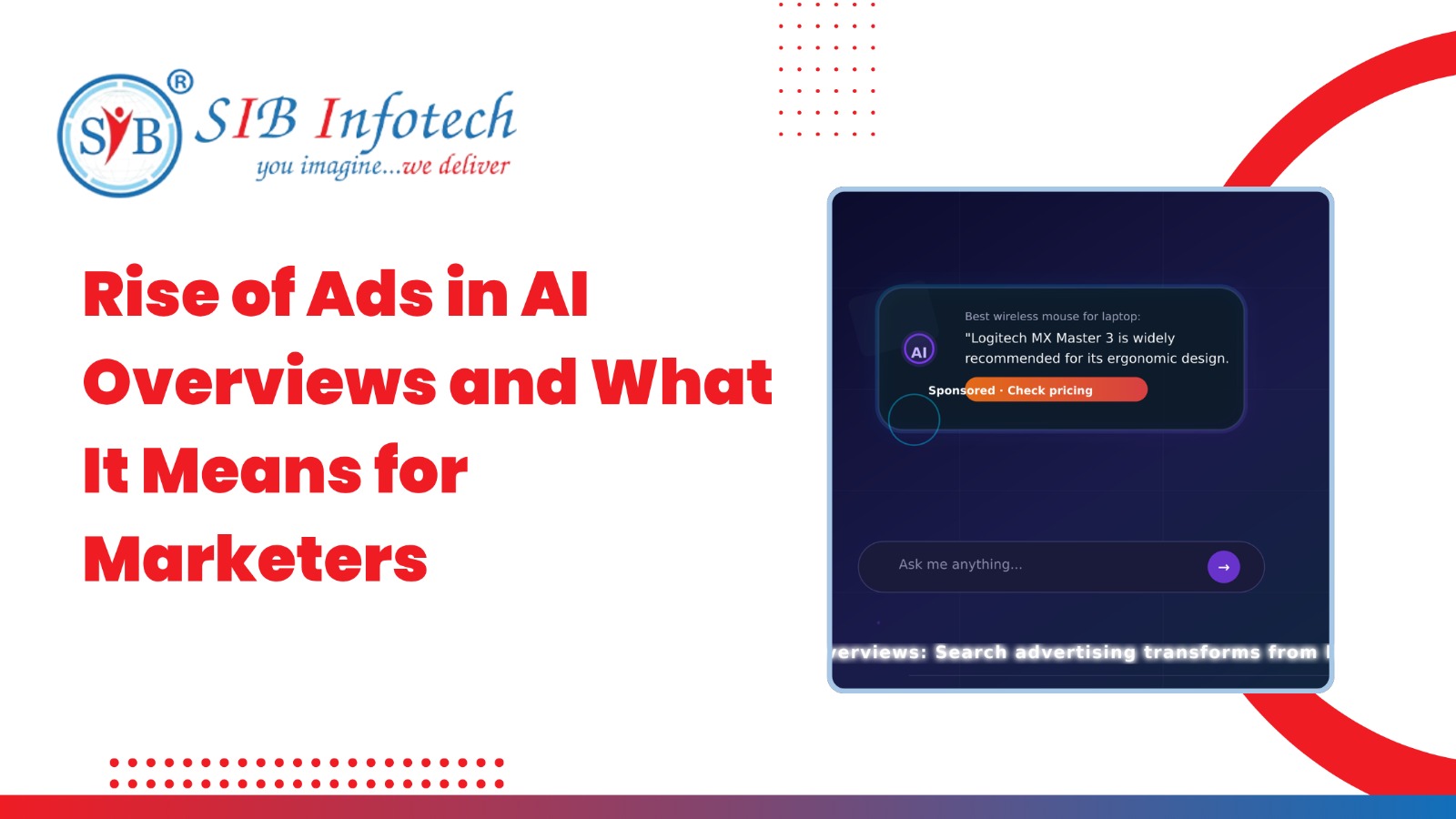
Imagine you ask, "What is the best wireless mouse for a laptop?"

The AI might answer, "The Logitech MX Master 3 is widely recommended for its ergonomic design. Many users also prefer the Apple Magic Mouse for its seamless integration. You can check pricing here [link]."

That final link could be a paid ad in AI overviews. It feels natural. It feels helpful. But a brand paid for that placement.

This subtlety is what makes it powerful and what makes marketers pay attention.

Similarly, ads in Google AI mode are appearing as Google tests its own AI powered search experiences. And paid ads in AI search are no longer just a concept. They are being bought and sold right now.

How Do Ads Inside AI Answers Actually Work?

The technology behind this is simpler than you might think, at least to understand.

Here are the basic steps:

  • 1
    Step 1: A user types a question.

    The question could be anything: "Best coffee maker under $100" or "How to remove a red wine stain from carpet."

  • 2
    Step 2: The AI reads for intent.

    Traditional search looked at keywords. AI looks at meaning. It asks: Does this person want to buy something? Compare products? Find a service? This process of how AI matches ads with user intent is the heart of the system.

  • 3
    Step 3: The AI matches commercial intent with relevant brands.

    If the AI decides the user has buying intent, it looks for relevant advertisers. Machine learning models predict which brand's ad will be most useful to that specific user at that specific moment.

  • 4
    Step 4: The ad appears inside the AI answer.

    Unlike a banner ad or a pop up, this ad feels like part of the conversation. It might be a product link, a store recommendation, or a suggested service.

This entire process happens in less than a second.

What makes this different from traditional AI in paid search advertising is the natural integration. Old paid search felt separate from results. New AI native ads feel like answers.

Real-World Proof: adMarketplace's New Tool (April 2026)

Let us move from theory to reality.

On April 30, 2026, adMarketplace released a tool that places advertisements within the responses of artificial intelligence search engines. You can read the full announcement in the latest AI powered martech news on MarTech.

Here is exactly what they built:

  • A machine learning model that matches commercial results with the intent of a user query.

  • A system that puts brand information in front of people using conversational tools to find products.

  • An advertising product designed specifically for AI search, not adapted from traditional search ads.

Why does this matter?

Because it proves that ads in AI are not a future prediction. They are live. Advertisers can use them today. And platforms like Google, Microsoft, and OpenAI will almost certainly follow with their own versions.

This is the moment when search advertising changed again.

The first big change was from print to digital. The second was from desktop to mobile. The third was from keywords to AI intent. And we are living through that third shift right now.

How This Compares to Traditional Search Advertising

To understand why this matters, you need to see the difference clearly.

Traditional search advertising (Google Ads, Bing Ads):

  • You bid on keywords.

  • Your ad appears in a separate section (top, bottom, or side).

  • Users must click to learn more.

  • The ad looks like an ad.

AI overview ads (new model):

  • The AI understands intent, not just keywords.

  • Your ad appears inside the AI written answer.

  • Users may not need to click (the answer is already there).

  • The ad looks like a helpful suggestion.

This difference changes everything.

The AI effect on search advertising is not small. It is fundamental. When users get answers directly, they click less. When they click less, traditional click based advertising loses value.

But new opportunities appear.

Brands can now appear inside the answer itself. That visibility is powerful even without a click. A user who sees your brand recommended by a trusted AI may remember you later. They may search for you directly. They may tell a friend.

So the game is not over. It is just different.

And AI in paid search advertising now means learning new skills: understanding intent matching, optimizing for AI citations, and buying placements inside AI generated responses.

How Brands Can Appear in AI Answers

This is the question every marketer asks first: How do I get my brand in there?

There are currently two paths.

Path 1: Organic (non paid) visibility

Even without paying, your brand can appear in AI answers if the AI trusts your content. How do you earn that trust?

  • Use structured data on your website (schema markup).

  • Publish authoritative, fact checked content.

  • Get cited by other reputable websites.

  • Optimize for Generative Engine Optimization (GEO), a new field focused on making your content easy for AI to read and cite.

Path 2: Paid visibility (ads in AI view)

This is where adMarketplace and similar tools come in. You pay to have your brand recommended inside relevant AI answers. The AI matches your offer to user intent. Your ad appears naturally within the response.

Most experts believe the future will combine both paths. You need good content to be cited organically, plus an ad budget to appear consistently for high intent queries.

The question of how brands appear in AI answers is still evolving, but these two paths are already clear.

What This Shift Means for Marketers

Let us get practical. Here is what changes for your job, your budget, and your strategy.

  • 1.
    Intent matters more than keywords.

    You cannot just bid on "best laptop" anymore. The AI wants to know, "Is this user comparing? Buying? Researching?" Your ad placement depends on matching that deeper intent.

  • 2.
    Metrics will change.

    Impressions inside AI answers will become a standard metric. Click through rate may drop, but brand visibility inside trusted answers may rise in value. You will need new reports and new dashboards.

  • 3.
    Budgets will shift.

    Money that went to traditional PPC will move toward AI native ad placements. Early movers will get cheaper access. Late movers will pay more.

  • 4.
    You need both content and ads.

    The brands that win will have great content (to be cited for free) and smart ad budgets (to appear consistently). You cannot skip either.

  • 5.
    Trust is fragile.

    If users feel tricked by hidden ads inside AI answers, they may stop using AI search altogether. Smart platforms and advertisers will prioritize transparency. The "Ad" label should be clear.

All of these changes trace back to one thing: the rise of ads in AI. This is not a small trend. It is a structural shift in how search works and how money moves online.

Benefits of AI Powered Ad Targeting

Despite the challenges, this new model offers real advantages.

Better relevance. When the AI understands intent, your ad reaches people who actually want what you sell. Less waste. Higher satisfaction.

Less interruption. Traditional ads stop you from reading. AI native ads feel like part of the answer. Users are more open to them.

Deeper insights. The AI knows what users really mean, not just what they typed. That data helps you build better products and messages.

New reach. People who ignore traditional ads may trust AI recommendations. This opens up audiences you could not reach before.

The benefits of AI powered ad targeting are substantial for brands that do it well. The key is respecting user trust while delivering genuine value.

Challenges and Concerns

Of course, this is not all good news. There are real concerns.

  • Transparency.

    Will users always know when an answer contains a paid ad? If not, trust erodes quickly.

  • Fairness.

    Will only big brands with big budgets appear in AI answers? Small businesses could be pushed out entirely.

  • Platform control.

    Google, Microsoft, and OpenAI control the rules. They can change algorithms overnight. Advertisers have less power than before.

  • Regulation.

    Government agencies like the FTC are already watching. New rules about AI advertising are likely within the next few years.

Smart marketers will watch these issues closely. The brands that prioritize transparency and fairness will build lasting trust.

The Future of AI Search Advertising

What comes next? Here are four predictions.

  • 1.
    More platforms will add this.

    Google AI Mode, ChatGPT search, Perplexity, and Bing will all offer ads in AI search within the next 12 to 18 months. Competition will drive innovation.

  • 2.
    Real time bidding will come to AI answers.

    Today, traditional search ads use real time auctions. Tomorrow, AI overview ads will too. Advertisers will bid for placement inside specific AI responses.

  • 3.
    AI shopping agents become new ad inventory.

    Imagine an AI agent that shops for you. Brands will pay to be recommended by that agent. This is the next frontier beyond search.

  • 4.
    Generative Engine Optimization (GEO) becomes standard.

    Just as SEO is standard today, GEO will be standard tomorrow. You will need someone who understands how AI reads, cites, and recommends content.

The future of AI in search advertising is bright, competitive, and full of opportunity for those who prepare now.

How SIB Infotech Can Help You Prepare

These changes can feel overwhelming. New technology. New rules. New risks.

But you do not have to navigate alone.

At SIB Infotech, we have been helping businesses stay visible online for over 20 years. With offices in Mumbai and New Delhi, we are a trusted name in website development and digital marketing, serving clients across India, the US, the UK, Canada, Australia, and beyond.

We specialize in website development and digital marketing strategies that evolve with search. We help businesses like yours stay visible, whether users type, ask, or speak their questions.

Here is how we help:

AI ready website development. We build websites with clean structure, fast loading, and proper schema markup so AI models can read and trust your content.

Modern digital marketing. Our strategies include traditional SEO, paid search, and emerging fields like Generative Engine Optimization (GEO) and AI native ad placements.

Clear guidance. We explain complex changes in simple terms. No jargon. No confusion. Just practical steps you can take.

If you are wondering how AI in paid search advertising affects your business, or if you simply want to future proof your online presence, we are here to help.

Contact us today and let us talk about what these changes mean for you and how we can keep your brand visible in the age of AI answers.

Conclusion

We are living through a historic shift.

Search results, those blue links we used for decades, are giving way to AI answers. And inside those answers, ads in AI are now appearing.

The adMarketplace tool, launched in April 2026 proved that this is not a theory. It is live. It works. And it will grow.

For marketers, this means learning new skills: understanding intent, measuring AI visibility, and buying placements inside conversations, not just search results.

The brands that adapt early will win. Those that wait may find themselves invisible.

The good news is that you do not need to figure this out alone. Whether you need a website that AI can read, a content strategy that earns citations, or a paid search plan that includes AI overviews, SIB Infotech is ready to help.

The future of search is already here. Let us make sure your brand is part of it.

Frequently Asked Questions