ADworld Experience 2026: What I Learned About PPC, AI, Automation, and Creative Strategy


By Anuj Bajaj, Co-founder, SIB Infotech · Published 11 November 2026 · Last updated 11 November 2026
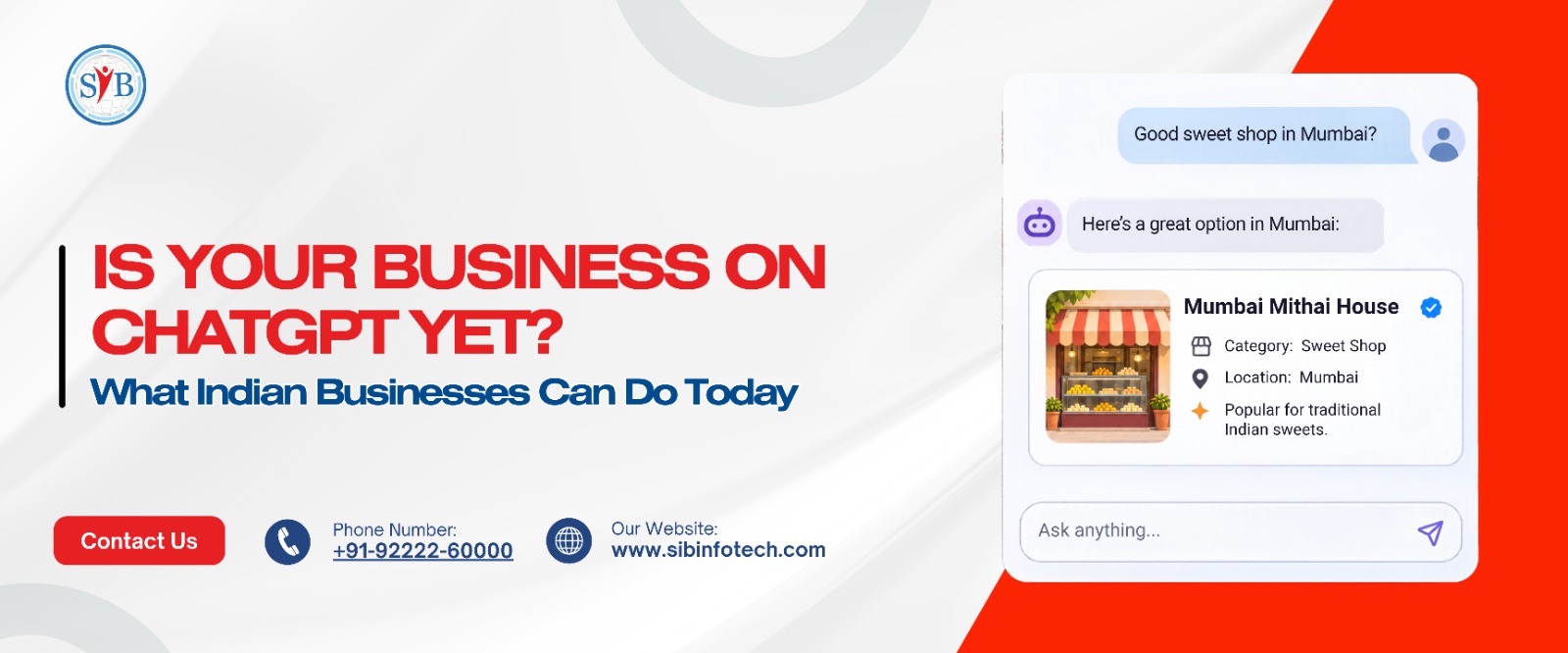
Businesses in ChatGPT is OpenAI's new beta that lets a business claim its profile inside ChatGPT, correct its details and see how often ChatGPT mentions it. Indian businesses can claim a profile and view insights today. The AI chat agent and local shop listings are limited to the US for now.
OpenAI launched the beta on 10 November 2026, and it pitches the programme at the 1.2 billion people it says use ChatGPT every week. A lot of those people ask ChatGPT which brand to buy or which company to call. Until this week, a business had no say in what ChatGPT told them.
It is a free dashboard called Business Hub where a verified owner manages how the business appears in ChatGPT and sees aggregated data on mentions and website clicks. Eligible US businesses can also publish a Business Agent, a chatbot that answers customer questions on the business's behalf.
You open the ChatGPT Business Hub from the sidebar or at chatgpt.com/business-hub. There are three parts, and you can use the first two without touching the third: the profile you control, the insights report, and the optional agent. OpenAI's own Businesses in ChatGPT page says a claimed profile shows a blue check, and that ChatGPT may show information about your business whether or not you claim it.
That last point matters more than it sounds. ChatGPT is already describing your business to people. Claiming simply lets you check what it says.
ChatGPT works like a well-read friend that millions of people ask for advice every day. Someone asks, "Which running shoes are good for flat feet?" or "Who makes good kitchen tiles in Mumbai?", and it suggests a few names.
Your business may already be one of those names. Until now, though, you had no say in what ChatGPT said about you. It could quote an old phone number, last year's price or a return policy you changed months ago, and you'd never know. Businesses in ChatGPT is your chance to put your hand up and say, "This is my business, and here are the correct details."
Your shop already shows up on Google Maps with your timings and phone number. This is the same idea inside ChatGPT.
Take a sweet shop in Dadar that delivers across Mumbai. A customer asks ChatGPT where to order kaju katli online, and ChatGPT names the shop. If the owner has claimed her profile, the customer sees the right website and description, plus a blue tick that tells them this is the real owner.
She proves ownership with an OTP on the business phone or email, or a small change to her website settings, and then shows an ID. It feels a lot like verifying a shop on Google.
Once the profile is claimed, ChatGPT gives the owner a simple report covering the last 28 days:
For the sweet shop, that might read as "your website came up in a few hundred answers, a few dozen people clicked, and most of them were asking about Diwali gift boxes". She never sees what any single customer typed. Only totals.
If you sell products, you can upload a list showing each item's price and whether it's in stock. It works like the price board outside a chemist's shop. When the board is right, customers trust it. When it's out of date, they walk out annoyed.
American online businesses can also put an AI helper on their profile. It's like a salesperson at your counter who never goes home. A customer asks, "Can I return a shirt I bought on sale?", and the helper answers from the rules you gave it, even at 2 am.
It's a bit like chatting with a business on WhatsApp, with a robot replying. But the helper can't take an order or a payment. It also can't check an order's status or give you the customer's number, so you can't follow up later the way you would on WhatsApp.
You can also pay for ads inside ChatGPT. When someone taps the ad, they start chatting with your AI salesperson instead of landing on your website, much like the Facebook ads that open a WhatsApp chat. These ads always carry a "Sponsored" label.
Claiming your profile won't push you to the top of ChatGPT's answers, and paying for ads won't change its normal recommendations either. Think of it as a good signboard. It makes sure people get the right information, and the buying decision stays with them.
Claiming and the AI helper are free today, and only the ads cost money. OpenAI hasn't ruled out charging later.
In one line, it's your Google Business listing and a WhatsApp-style helper rolled into ChatGPT. Indian businesses can claim a profile and read the report today, and the helper will follow.
Profile claiming and insights work in India. The agent, local store claiming and the standard product feed upload are US-only for the moment.
| Feature | Available in India today? | Who gets it |
|---|---|---|
| Claim a profile, blue check, edit details | Yes | Eligible businesses with a website, wherever ChatGPT is available |
| Insights (mentions, clicks, discovery topics) | Yes, once verified | Same as above |
| Add a new online business with no listing | Yes | Eligible online businesses |
| Claim a local store or restaurant listing | No | Existing US listings only |
| Standard product feed upload | Not by default | Targets the US; other markets need OpenAI to confirm the integration |
| Business Agent | No | Eligible US ecommerce and online service businesses |
| Sponsored agent as an ad destination | No | Tied to ChatGPT Ads in the US |
The table comes from Flavio Copes's walkthrough of OpenAI's setup guide, which lists who gets each feature. You don't need a ChatGPT Ads account or an Enterprise contract to claim, according to The Keyword's launch report.
So a dental clinic in Andheri or a coaching class in Thane can't claim a local listing yet. A D2C skincare brand or a SaaS company with a website can claim today.
You search for your business in Business Hub, prove you own it, wait for OpenAI's review, and then pass a separate identity check with Persona. The blue check appears only after that second check is approved.
Ownership can be proved four ways. You can take a code on the business phone, take a code on the business email, add a DNS TXT record to your domain, or connect a Shopify store. For most of our clients at SIB Infotech, I recommend the DNS record as the cleanest route, because it's the same kind of proof Google Search Console asks for and the IT team has usually done it before.
The Persona step trips people up. It may ask for a government ID, business registration details and proof that you can represent the company, and the name and registration number have to match official records. If a junior marketing executive starts the claim, the founder or a director will probably need to finish it.
Two details are easy to miss. When you create a brand-new profile, OpenAI's approval publishes it automatically, and its support team can't delete or unpublish a published profile. And every edit you make goes through review before it shows, so don't expect a changed return policy to appear the same afternoon.
Insights show mentions, website clicks and discovery topics for the past 28 days. For an online business, a mention counts only when ChatGPT links to your website, so a brand named without a link doesn't register.
That rule cuts hard against manufacturers. In one test reported by Flavio Copes, ChatGPT recommended seven sock brands and retailers, but two of the brands it named got zero links because ChatGPT pointed people to retailers instead. A paint company or a pump maker that sells through dealers could be recommended often and still see small numbers in Business Hub.
Small businesses may also see blank metrics. OpenAI only shows a figure once activity crosses a reporting threshold, and a blank isn't the same as zero. You never see individual prompts or conversations.
You don't have to wait for Business Hub to start measuring. ChatGPT adds utm_source=chatgpt.com to the links it shows, so a GA4 report filtered on that source will tell you how many visits ChatGPT already sends. At SIB Infotech, we set that report up before any GEO work starts, because it gives a baseline the client can trust.
A Business Agent is an AI chat that sits on your ChatGPT profile and answers questions from the product and policy information you give it. A customer opens your profile, chooses to chat, and gets a separate, labelled conversation with your business.
Think of it as a WhatsApp Business chat where a bot replies instantly at 2 am. The comparison breaks down quickly, though. The agent can't complete purchases, take bookings or check an order, and it sends people to your website for those. OpenAI doesn't share the chats with you, so you get no phone number and no way to follow up.
OpenAI's policy also sets firm limits on what the agent can say. It must admit it's an AI, can't invent prices or stock, can't create false urgency, and can't ask for ID or financial details. OpenAI reviews the agent every time you change it.
For Indian sellers this is a waiting game. When it does open up, the businesses with clean policy pages and accurate product data will have the easiest setup.
Both, with a couple of other Google tools thrown in. Business Hub works like Google Business Profile, Merchant Center and Search Console combined, while the Business Agent sits closer to WhatsApp Business with a bot, and the sponsored agent is ChatGPT's answer to Click-to-WhatsApp ads.
| Businesses in ChatGPT | Closest equivalent | How close |
|---|---|---|
| Claim and verify a profile, blue check | Google Business Profile claim and verification | Very close |
| Edit description, logo, cover photo, category, policies | Google Business Profile editing | Very close, though OpenAI reviews every edit |
| Persona identity check | Meta Business Verification, Google advertiser verification | Close |
| Product feed (CSV or JSONL with price and stock) | Google Merchant Center feed | Close, with only 9 required fields |
| Shopify connection | Shopify's Google and YouTube app, Meta catalogue sync | Same idea |
| Insights: mentions, clicks, discovery topics | Business Profile performance plus Search Console | Partial, because topics are grouped themes and you never see actual queries |
| Business Agent | WhatsApp Business with an automated bot | Partial |
| Sponsored agent as an ad destination | Meta Click-to-WhatsApp and Click-to-Messenger ads | Very close in concept |
| Claiming doesn't improve ranking | Same rule on Google Business Profile and organic search | Same |
The claiming flow is almost identical. A business finds and verifies its listing, then controls its information and sees how often it gets shown and clicked.
The gap is in what each one serves. Google Business Profile is built for the shop down the road: Maps, calls and directions. Businesses in ChatGPT is built for online businesses, and local stores can only claim an existing US listing. Some Google staples are missing too, such as replying to reviews or tracking calls.
Greg Isenberg called the launch a possible "google my business moment for ai", recalling how agencies earned well in the 2010s claiming and fixing listings for local businesses. I agree with him on the direction, because I watched that Google listing rush happen. For Indian local businesses, though, that moment hasn't arrived, because there's nothing for them to claim yet.
A customer starts a conversation with the business, and that part feels like WhatsApp. Three differences matter a great deal to anyone who runs sales on WhatsApp today.
First, you don't own the conversation. WhatsApp gives you the customer's number and chat history, so you can follow up or retarget. ChatGPT shares none of the chats with the business, so no lead is captured.
Second, the agent can't hand over to a person or close a sale, whereas WhatsApp in India supports payments and a live salesperson. Third, it only replies. WhatsApp lets you send broadcasts and templated follow-ups, while the ChatGPT agent speaks only when a user opens it.
So the agent is closer to Google's old Business Messages, the chat button on Business Profiles that Google switched off on 31 July 2024, with an AI doing the talking. Google is chasing the same idea again: in September it began a US retailer beta that places its own Business Agent inside YouTube ads.
The paid side is growing fast. OpenAI's ad business passed a $1 billion annual run rate in August with 100,000 advertisers. Early results are mixed, though: the Shopify ChatGPT app had a 2.0 rating on launch day, and one merchant reported spending USD 25 on 17 clicks.
"It's your Google Business Profile and Merchant Center for ChatGPT, plus an AI salesperson who sits on that profile and answers pre-sale questions round the clock. You can also run ads that send people straight to that salesperson, the way Click-to-WhatsApp ads do on Facebook and Instagram."
In practice, the setup work (claiming, verification, profile and feed accuracy) sits next to Google Business Profile management. The agent and sponsored agent work belongs with Click-to-WhatsApp campaigns and ChatGPT Ads.
If I had five minutes with OpenAI's CEO, my message would be short. It's a strong first version, but right now it asks businesses for a lot of work and gives them very little back.
Some of these go beyond fixing the beta. They're ideas I think could make ChatGPT the place Indian businesses actually want to be listed.
The pitch fits in a sentence. Google won local business by being free, by giving owners something useful every month and by letting agencies do the heavy lifting, and if OpenAI copies those three things and adds leads a business can actually call back, Businesses in ChatGPT could become the next Google Business Profile.
Claim your profile now if you have a website and sell online, and fix your delivery and return policies before you do anything else. Those two pages are what ChatGPT, and later your agent, will quote to customers.
Then set up the utm_source=chatgpt.com report in GA4 and note your current ChatGPT traffic, so you can tell later whether the profile changed anything. OpenAI says plainly that claiming doesn't guarantee higher placement or sales.
If you run a local business in India, nothing is claimable yet. Use the time to tidy the things ChatGPT reads elsewhere: your Google Business Profile, your website's service pages and your reviews.
At SIB Infotech, we're helping clients claim and verify their ChatGPT profiles and set up the tracking around them. If you'd like a check of what ChatGPT currently says about your business, talk to the SIB Infotech team.
This guide is based on OpenAI's own launch announcement, product page, setup guide and Business Agents policy, read on launch day and cross-checked against independent coverage listed under Sources. Where a detail came from a third party rather than OpenAI, the link sits next to the claim. Businesses in ChatGPT is a beta, so I'll review this page monthly and update the date above when anything changes.
A quick disclosure: SIB Infotech offers ChatGPT SEO, ChatGPT Ads and Google Business Profile services, and some links in this article point to those pages.
No. OpenAI lists no fee for claiming, and ChatGPT Ads are a separate paid product.
Our 4.8 average client rating is built on delivering the results we promise. From SEO rankings and lead generation to web development and paid marketing, our clients across 40+ countries have shared their experience publicly.
4.8

Digital Marketing and SEO Agency Reviews about SIB Infotech


Rupesh Maniar
Real Value Finloan Services Pvt. Ltd.
SIB Infotech has designed website for our company. We are very happy with outcome. They are not only professional but also putting their heart into work. We will always refer them for quality work and perfect price.
Reviewed From


Tima Elhajj
CEO & Founder, Tima Media
The client loved the platform that the SIB Infotech team developed for them, especially the calculator function. The company appreciated the team's high level of professionalism, communication, and care on the project. They are happy and willing to work with the team again.
Reviewed From