Digital Marketing for Small Businesses in India: Platforms, Tools and Strategy

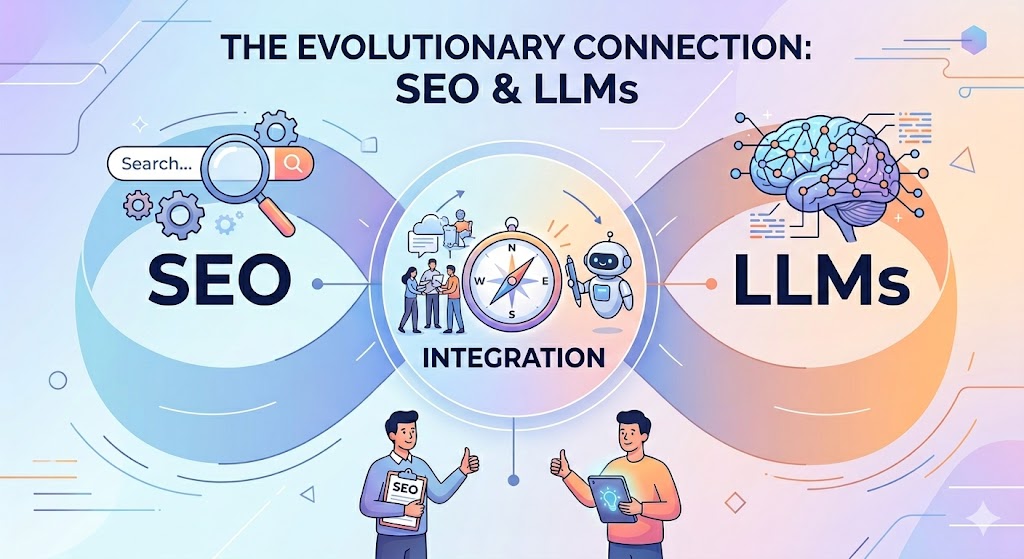

Search engine optimisation has never stood still. Every few years, something shifts that forces website owners, marketers, and content creators to rethink how they approach being found online. The rise of large language models is one of those shifts. Except this one is bigger than most
In this blog, we break down the relationship between SEO and large language models in plain language. No jargon overload, no overcomplicated theory. Just what you need to understand what has changed, why it matters, and what you can actually do about it
Large language models aren't just a separate destination competing with search engines for attention — they've become embedded directly inside how modern search engines understand and rank content. Google's own systems increasingly use language-model-based understanding to interpret query intent and evaluate content relevance, meaning LLM-style comprehension is now part of the ranking process itself, not just a parallel, external phenomenon happening in ChatGPT or Gemini's standalone chat interfaces.
Content historically optimized around exact keyword matching and density now competes against a ranking and citation system that understands meaning and context far more fluently than older, purely lexical algorithms did. This means content genuinely answering a question well, in clear language, tends to outperform content mechanically stuffed with target keywords — a shift that rewards better writing and clearer thinking, even as it demands more genuine expertise from content creators than keyword research alone ever did.
Pro Tip: Read your own content and ask honestly: would this actually satisfy someone's question completely, or does it require them to piece together an answer from multiple vague sentences? LLM-influenced ranking systems are increasingly good at detecting the difference.
Beyond traditional ranking, LLMs introduce an entirely new visibility layer: being directly cited or referenced when a user asks an AI assistant a question, rather than appearing in a list of links a user has to click through themselves. This is a meaningfully different outcome from ranking #1 — a citation inside a generated answer can drive brand visibility and trust even without a click, while a traditional ranking depends entirely on the user choosing to click through.
Despite the shift, core SEO fundamentals — technical crawlability, fast page speed, clear site structure, genuine expertise, and earning trust signals — remain just as relevant under LLM-influenced ranking as they were before. LLMs haven't replaced the need for a technically sound, well-structured website; they've added an additional layer of content quality expectation on top of those existing fundamentals.
| What Stayed the Same | What Changed |
|---|---|
| Technical crawlability and site speed still matter | Content is evaluated on genuine meaning, not just keyword matching |
| Backlinks and trust signals remain relevant | A new citation-based visibility layer exists alongside ranking |
| Clear site structure still helps both users and crawlers | Direct, complete answers now outperform keyword-dense filler |
Large language models haven't replaced SEO — they've merged with it, embedding language understanding directly into ranking systems while adding a new citation-based visibility layer on top. The businesses adapting best are the ones treating this as an evolution of good SEO practice, not an entirely separate discipline requiring a completely different strategy. Our SEO services and Generative Engine Optimization (GEO) work together specifically because the underlying fundamentals — genuine expertise, clear answers, technical soundness — drive both traditional rankings and AI citations at the same time.
Our 4.8 average client rating is built on delivering the results we promise. From SEO rankings and lead generation to web development and paid marketing, our clients across 40+ countries have shared their experience publicly.
4.8

Digital Marketing and SEO Agency Reviews about SIB Infotech


Rupesh Maniar
Real Value Finloan Services Pvt. Ltd.
SIB Infotech has designed website for our company. We are very happy with outcome. They are not only professional but also putting their heart into work. We will always refer them for quality work and perfect price.
Reviewed From


Tima Elhajj
CEO & Founder, Tima Media
The client loved the platform that the SIB Infotech team developed for them, especially the calculator function. The company appreciated the team's high level of professionalism, communication, and care on the project. They are happy and willing to work with the team again.
Reviewed From