
Digital Marketing for Small Businesses in India: Platforms, Tools and Strategy

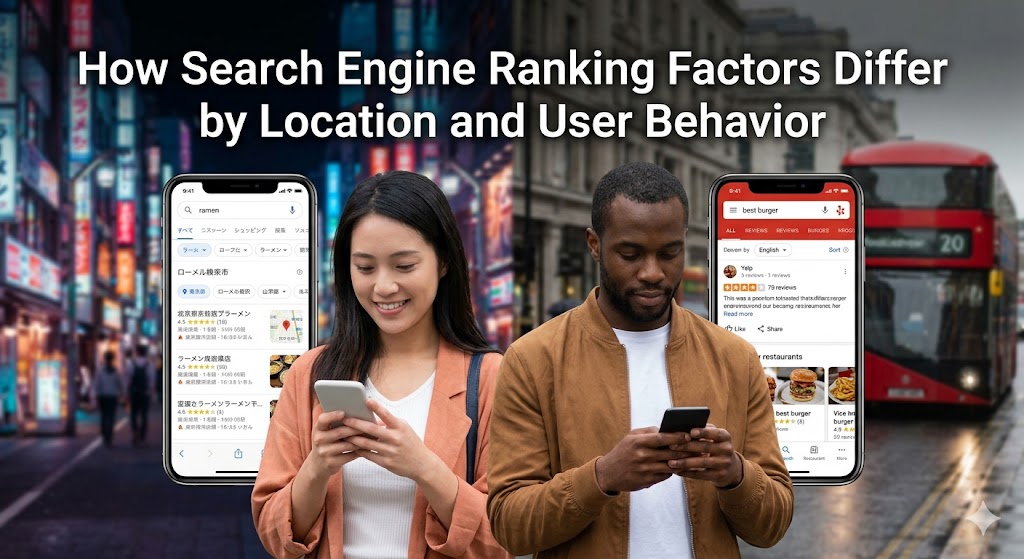

Two people can type the exact same word into Google at the exact same time and receive two completely different sets of results. This is not a coincidence. It is how modern search engines are designed to work. Search engines do not treat every user as identical. The results a person sees are shaped by a combination of factors unique to that individual. Where they are located, how they have previously behaved online, what device they are using, and what age group they belong to all influence what appears on their screen. This article examines how and why search engine ranking factors differ based on geographic location and individual user behavior, and what this means for how search results are generated.
Google's ranking system layers personalization signals on top of its core relevance algorithm, meaning the "objective" ranking for a keyword is really closer to a baseline that gets adjusted per user based on location, device, browsing history, and inferred intent. This is precisely why a business owner checking their own ranking from their office computer can see a very different position than what an actual customer searching from a different city, on a phone, sees for the same term.
Location influences search results at two distinct levels: the local pack (map-based results tied directly to proximity) and organic rankings more broadly, where Google infers that users in different regions may have different intent even for the same keyword. A search for "best pizza" produces an almost entirely location-driven result set, but even a broader informational query can be subtly reordered based on regionally popular sources or region-specific relevance signals Google's algorithm has learned over time.
Pro Tip: When checking your own rankings, use a rank-tracking tool that lets you specify a target location matching your actual customer base, rather than checking from your own browser — the two can differ significantly, especially for locally-relevant search terms.
Google incorporates a user's own search and click history into how it ranks results for that individual, on the theory that past behavior is a reasonable predictor of future intent. A user who frequently clicks on technical, in-depth content may see more of that content type prioritized across future searches, while a user who consistently clicks on quick, simple answers may see more concise results favored — meaning two users with identical demographic profiles can still see different rankings based purely on their own accumulated interaction patterns.
Mobile and desktop search results are not identical, even for the same query from the same location — mobile results tend to favor pages optimized for smaller screens, faster load times, and often show more local pack and map results prominently, reflecting the higher likelihood that a mobile searcher has immediate, location-relevant intent compared to a desktop searcher who may be doing more extended research.
Google also incorporates broader inferred signals — age range estimates, general interest categories built from browsing patterns, and language preferences — into the personalization layer, subtly adjusting which sources and content styles get prioritized for different inferred audience segments, even without any single factor being decisive on its own.
| Factor | How It Shapes Results |
|---|---|
| Geographic location | Local pack results and regionally-relevant organic reordering |
| Search and click history | Favors content styles the user has previously engaged with |
| Device type | Mobile favors fast, local-relevant results; desktop favors deeper content |
| Inferred demographics | Subtle adjustments to source and content style prioritization |
Search engine ranking factors are never truly universal — they're filtered through location, behavior, device, and inferred intent for every individual searcher. Businesses that check their own rankings from a single, unlocalized viewpoint risk drawing the wrong conclusions about their actual visibility. A proper SEO audit accounts for this personalization layer directly, checking how your business actually appears across the locations, devices, and search contexts your real customers use.
Our 4.8 average client rating is built on delivering the results we promise. From SEO rankings and lead generation to web development and paid marketing, our clients across 40+ countries have shared their experience publicly.
4.8

Digital Marketing and SEO Agency Reviews about SIB Infotech


Rupesh Maniar
Real Value Finloan Services Pvt. Ltd.
SIB Infotech has designed website for our company. We are very happy with outcome. They are not only professional but also putting their heart into work. We will always refer them for quality work and perfect price.
Reviewed From


Tima Elhajj
CEO & Founder, Tima Media
The client loved the platform that the SIB Infotech team developed for them, especially the calculator function. The company appreciated the team's high level of professionalism, communication, and care on the project. They are happy and willing to work with the team again.
Reviewed From