

Google Ads Keyword Match Types Explained (2026 Guide with Smart Bidding)
.webp&w=3840&q=100)
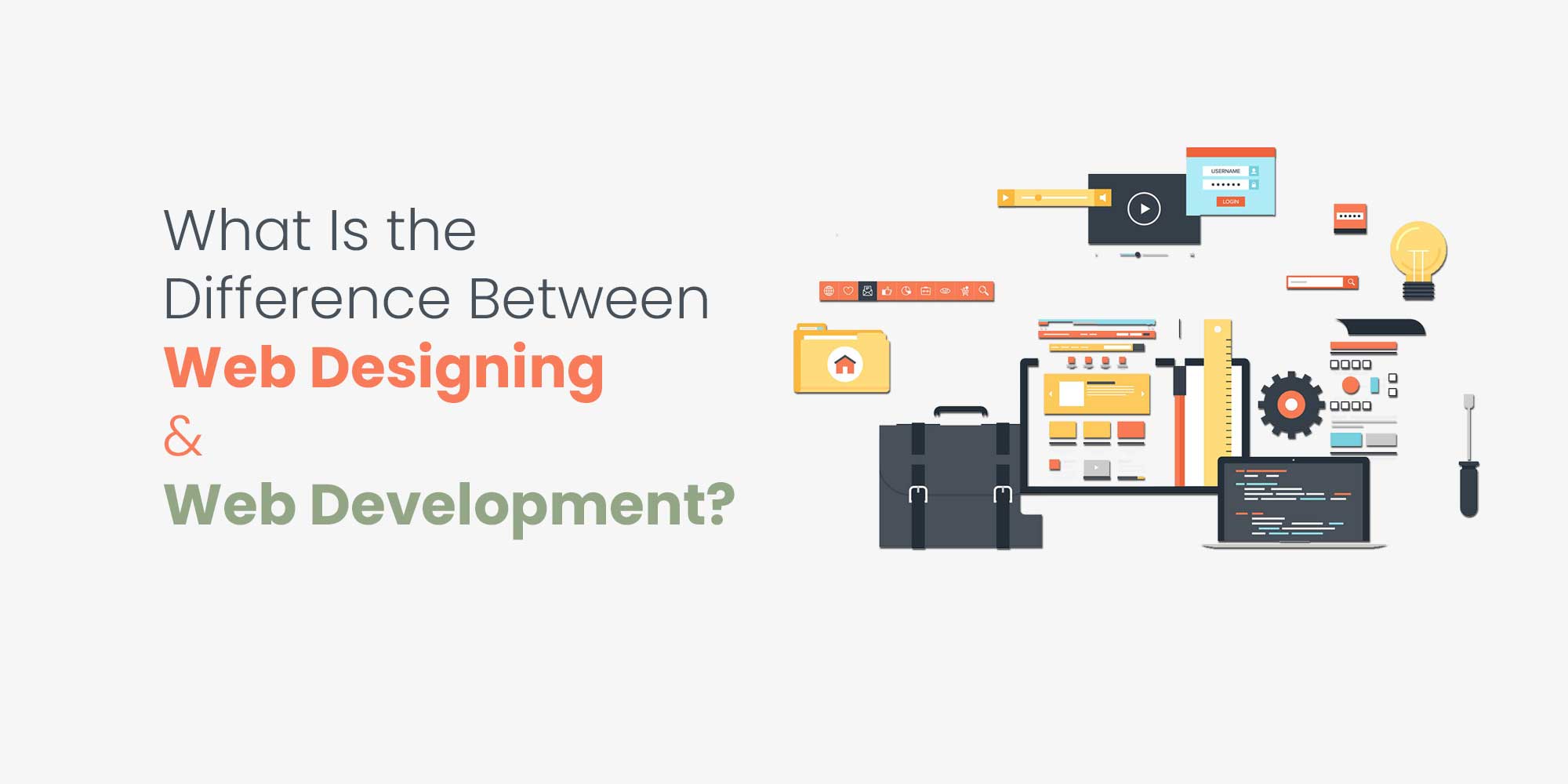

Web design decides what a website should do and how it should look and behave. Web development builds the thing that does it. Design produces the plan; development produces the working software.
The common shorthand — designers make it pretty, developers make it work — is wrong in a way that causes real problems on projects, because it implies design is decoration you could skip. Design is a set of decisions about structure, priority and behaviour. Skipping it does not save money; it moves the decisions to whoever writes the code, at the point where changing them is most expensive.
| Web design | Web development | |
|---|---|---|
| Question answered | What should this do, and how should it feel to use? | How do we make it actually do that, reliably? |
| Output | Structure, layouts, components, specifications | Working code, deployed and maintainable |
| Judged on | Whether people can accomplish the task | Whether it works correctly, quickly and securely |
| Typical tools | Figma, prototyping tools, design systems | HTML, CSS, JavaScript, server languages, databases, Git |
| Fails as | A site that looks good and confuses people | A site that works and nobody wants to use |
Most of the work happens before anything looks like a website.
Who uses it, what they are trying to accomplish, what the business needs to happen. A designer who skips this produces attractive layouts that solve the wrong problem — the most expensive kind of mistake, because it survives until launch before anyone notices.
How content is organised, what the navigation contains, what lives where, what a page is called. This determines whether people find things. It is invisible when done well and the single most common cause of "the site is nice but I can never find anything."
Deciding what the eye reaches first, second and third on every screen. Hierarchy is the working part of visual design — it directs attention. Choosing what to emphasise means choosing what to subordinate, which is why "make everything prominent" briefs produce flat, hard-to-scan pages.
What happens on click, on hover, on focus, while loading, when a form is submitted, when something fails. Empty states, error states and loading states are design work, and they are the states most often left unspecified — which is exactly when a developer has to invent them under time pressure.
Modern design work produces a component system rather than a stack of page pictures: buttons, form fields, cards, spacing scales, type scales, colour tokens. This is what makes a site consistent and extensible. A design delivered as twelve unique page layouts with no shared components will drift within months of launch.
Development splits into two halves that are genuinely different jobs.
Everything that runs in the browser. Turning designs into HTML and CSS, making layouts respond across screen sizes, building interactive components, handling forms and validation, ensuring keyboard and screen-reader access, and keeping the page fast.
Front-end is where responsive design is actually implemented, and it is where a great many design intentions are silently lost — usually because the design specified one width and the front-end had to invent the rest.
The core technologies are stable and well documented: HTML for structure and meaning, CSS for presentation, and JavaScript for behaviour. Semantic markup matters more than it looks — the difference between a <button> and a styled <div> is invisible on screen and decisive for anyone using a keyboard or screen reader.
Everything that runs on the server. Data modelling and databases, application logic, authentication, integrations with payment providers and CRMs, the content management system, security, and performance under load.
Back-end work is invisible when correct. It becomes visible as a data breach, a checkout that loses orders, or a site that collapses on the one day traffic spikes.
The neat split above breaks down at the front-end, and that is where most confusion — and most project friction — lives.
Front-end developers write code, so they are developers. But they make dozens of design decisions daily: what happens at widths nobody drew, how a component behaves with three words or thirty, what a focus state looks like, how a table works on a phone. Every gap in a specification becomes a front-end decision.
This is why "UI developer", "front-end designer" and "design engineer" all exist as titles. They describe people who work across the line deliberately. On a well-run project, front-end is a conversation between design and development rather than a handoff between them.
The practical consequence for anyone commissioning work: ask who owns the decisions the designs do not cover. If nobody owns them, they get made by whoever hits them first, at whatever moment they hit them.
Job adverts and agency proposals use a dozen overlapping titles, and the overlap is genuine rather than a failure of your understanding. A rough map:
| Title | What it usually means |
|---|---|
| UX designer | Structure, flows, research, usability. Often produces wireframes rather than finished visuals. |
| UI designer | The visual layer — components, type, colour, states. Works from UX output. |
| Product designer | Both of the above, plus involvement in what gets built and why. |
| Web designer | Commonly all of the above for websites specifically, often including basic front-end. |
| Front-end developer | Browser-side code. May or may not make design decisions depending on the team. |
| Full-stack developer | Front-end and back-end. Depth varies enormously — worth probing in interview. |
| Design engineer | Deliberately spans the line; builds design systems in code. |
Do not over-index on titles. Ask what the person's last three projects involved and which decisions they personally made. That reveals more than any label, particularly at agencies where one person often covers several of these rows.
The handoff has changed materially and it is worth knowing what good looks like, because it is where budget quietly disappears.
Rather than a developer reading values off a picture, mature teams define colour, spacing, type sizes and radii as named tokens — color-surface, space-4, text-lg — which exist identically in the design tool and in the stylesheet. A change to a token propagates everywhere instead of requiring twelve edits and a QA pass.
If a proposal describes deliverables as "final designs in Figma" with no mention of components or tokens, expect drift between the design and the built site within months.
A useful handoff answers the questions the layouts do not: what happens between breakpoints, what a component does with unexpectedly long content, what every interactive element looks like on hover, focus, active and disabled, and what appears when data is empty or a request fails.
When designers and developers name the same component differently — "card" versus "tile" versus "panel" — every conversation carries a translation cost and bugs get filed against the wrong thing. Naming components once, together, is a small act with a disproportionate return.
| Web design | Front-end | Back-end |
|---|---|---|
| User research and testing | HTML, CSS, JavaScript | A server language — PHP, Python, Node, Java |
| Information architecture | Responsive layout and CSS architecture | Databases and data modelling |
| Typography and layout | Component frameworks | APIs and integrations |
| Colour and contrast | Accessibility implementation | Authentication and security |
| Prototyping | Performance optimisation | Caching and scaling |
| Design systems | Cross-browser testing | Deployment and infrastructure |
| Writing interface copy | Build tooling | Version control and code review |
Accessibility deserves particular note here because it is the requirement most often assigned to nobody. The W3C's WCAG guidelines set the standard, and meeting them is a joint obligation: colour contrast and focus visibility are design decisions, while semantic markup, keyboard order and screen-reader labelling are development ones. Neither discipline can deliver it alone.
Two things belong to everyone rather than to one column. Accessibility is decided in design — contrast, target sizes, focus order, whether meaning is carried by colour alone — and implemented in front-end. Treating it as a developer task at the end guarantees retrofitting. Performance is similar: a design specifying four web fonts and a full-bleed video has set a performance budget, whatever the developer does afterwards.
The tidy sequence — design finishes, development starts — is how projects are quoted and almost never how they work well.
What works better is overlap. Developers review designs while they are still changeable and flag what is expensive or impossible. Designers stay involved through build to answer the questions the designs did not anticipate. Both are present when scope is cut, because cutting the wrong thing breaks the system.
A realistic shape:
The detail of how these phases are run, and who is accountable at each, is covered in how a web project actually runs.
Four failure patterns account for most of it, and all are avoidable.
Designs for one screen width. A desktop comp with no guidance for anything narrower leaves every intermediate layout to be improvised. Specify at least a narrow and a wide state for each template.
No component thinking. Twelve bespoke page designs with subtly different buttons produce twelve bespoke implementations, and a site that cannot be extended without a designer.
Unspecified states. No error state, no empty state, no loading state, no long-content state. These get invented during build, inconsistently.
Content arriving last. Designs built around placeholder text collapse when real content is twice as long and includes an eight-word product name. Design with real content, or at least realistic content.
A practical way to decide, based on what you already have.
| Situation | What you need |
|---|---|
| No site, starting from nothing | Both. Design first, with development involved early. |
| Site looks dated but works fine | Design, plus front-end to implement. Back-end likely untouched. |
| Site looks fine but is slow, breaks, or fails on mobile | Development. Design is not your problem. |
| People cannot find things or do not convert | Design — specifically structure and UX, not a visual refresh. |
| Need a new feature on an existing site | Development, with design input if it introduces new interface patterns. |
| Have designs already, need them built | Front-end development. Have them reviewed for feasibility first. |
The row people most often get wrong is the fourth. Poor conversion is regularly treated as a visual problem and answered with a redesign, when the actual cause is structural — unclear navigation, buried information, an unexplained form. A prettier version of a confusing site is still confusing.
Whether you are briefing an agency or a freelancer, five questions surface most of what proposals leave vague:
Answers that are specific are a good sign regardless of what they say. Answers that are reassuring but vague usually mean the question has not been considered.
Both are legitimate paths and the honest distinction is what you enjoy being stuck on.
Design suits people who like ambiguous problems with no verifiably correct answer, who can defend a decision without proof, and who are comfortable with subjective critique. Development suits people who like problems with a definite answer, immediate feedback, and the specific satisfaction of making something work.
Front-end is a reasonable entry point to either, since it touches both. Whichever you choose, understanding enough of the other to have a productive argument with them is what separates people who are pleasant to work with from people who are not.
Design decides what a site should do and how it should look and behave; development builds it. Design produces structure, layouts, components and specifications. Development produces working, deployed code. Design answers "what and why"; development answers "how".
Establishes what the site is for and who uses it, organises content and navigation, designs layouts and visual hierarchy across screen sizes, specifies interaction and states, and builds a reusable component system. The visual polish is the last and smallest part.
Front-end developers build what runs in the browser — markup, styling, responsive behaviour, interactive components, accessibility and performance. Back-end developers build what runs on the server — databases, application logic, authentication, integrations, security and the CMS.
Yes, and many do, particularly on smaller sites. Beyond a certain complexity the disciplines diverge enough that depth in both is rare. A generalist is often the right choice for a small business site and the wrong one for a large ecommerce build.
Design, in almost every case — but with a developer reviewing the designs before they are finalised. Building without design means the decisions get made in code, where changing them costs the most.
Formally development, practically both. Front-end developers make design decisions constantly, because no specification covers every screen size, content length and interaction state. The useful question on a project is not which label applies but who owns the decisions the designs do not cover.
Design is the plan; development is the build. The projects that go badly are usually the ones where the plan was thin, so the decisions got made during the build by whoever encountered them — under deadline, without context, and inconsistently.
If you are commissioning a site, our website design services and web development services are run as one engagement for exactly this reason: the handoff between them is where most website projects lose their way.
Our 4.8 average client rating is built on delivering the results we promise. From SEO rankings and lead generation to web development and paid marketing, our clients across 40+ countries have shared their experience publicly.
4.8

Digital Marketing and SEO Agency Reviews about SIB Infotech


Rupesh Maniar
Real Value Finloan Services Pvt. Ltd.
SIB Infotech has designed website for our company. We are very happy with outcome. They are not only professional but also putting their heart into work. We will always refer them for quality work and perfect price.
Reviewed From


Tima Elhajj
CEO & Founder, Tima Media
The client loved the platform that the SIB Infotech team developed for them, especially the calculator function. The company appreciated the team's high level of professionalism, communication, and care on the project. They are happy and willing to work with the team again.
Reviewed From